

Nine Arizona Adventures: A Trail Ride Through L. Ron Hubbard’s Frontier
Saddle up. Somewhere between 1936 and 1950, while he was also busy writing the iconic science fiction and fantasy novels he is famous for today, L. Ron Hubbard kept riding back to one particular patch of real estate: Arizona. Nine times, to be exact. Nine Western tales set among its deserts, its cattle ranges, its mining camps, and its dusty one-street towns. Some are shoot-’em-ups, some are mysteries, one is practically a survival thriller, and one is a fish-out-of-water comedy. Ride through all nine and you start to see why the territory had such a grip on him. Better yet, most of them still read in a single sitting, so you can sample a few tonight. So grab your hat. This is the quick tour.
First, Why Arizona? A Territory Still Half-Wild
In Hubbard’s day, Arizona was barely a generation past its frontier youth. It had become a state only in 1912, and it still had everything a storyteller could want. A real frontier police force in the Arizona Rangers, a few dozen men covering ground the size of a small country. Water so scarce that owning a creek could mean owning your neighbors. Gold and copper enough to turn quiet men dangerous. And distances so wide that the nearest sheriff might as well have been on the moon. Drop a decent man into a place like that, hand him a problem, and the story practically writes itself. Hubbard just had to keep up.
A Cowboy Behind the Typewriter: He Came by It Honestly
Here is the part that makes the Arizona stories ring true: Hubbard was not guessing. He grew up in and around Montana ranch country and had been riding horses since the age of three and a half, in a cut-down cavalry saddle. He counted old frontiersmen, working cowboys, and a tribal medicine man among the people who raised him. When he put that firsthand knowledge of the Western frontier into his fiction, he did it at a full gallop, publishing sixteen Western stories in 1938 alone, under his own name and a string of gloriously colorful pen names, our favorite being Winchester Remington Colt.
Now, the rides.
The Nine Rides: Pick Your Trail
1. “The Baron of Coyote River” (All Western Magazine, 1936)
Hubbard’s very first Arizona outing throws a fugitive and a mysterious man of the range together against a nest of cattle rustlers. It has everything a 1936 reader paid a dime for: hard riding, hidden identities, and a last-minute reversal. By the final page, two men who spent the whole story a half-step outside the law are wearing United States deputy marshal badges. Outlaws today, lawmen tomorrow. Welcome to the frontier.
Currently available as part of the Stories from the Golden Age series, in the book The Baron of Coyote River.
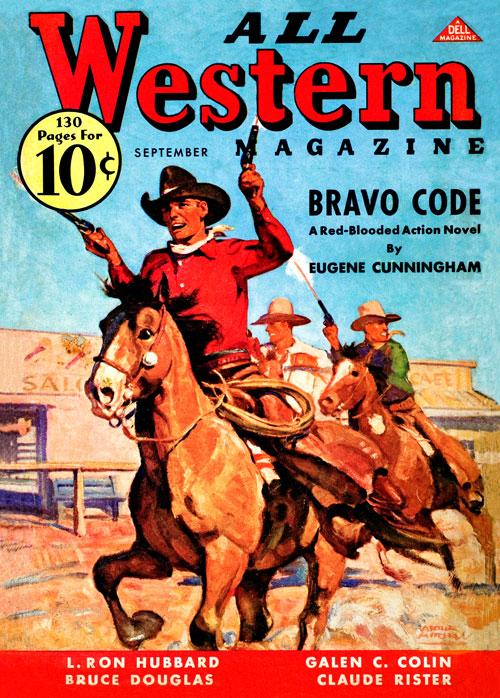
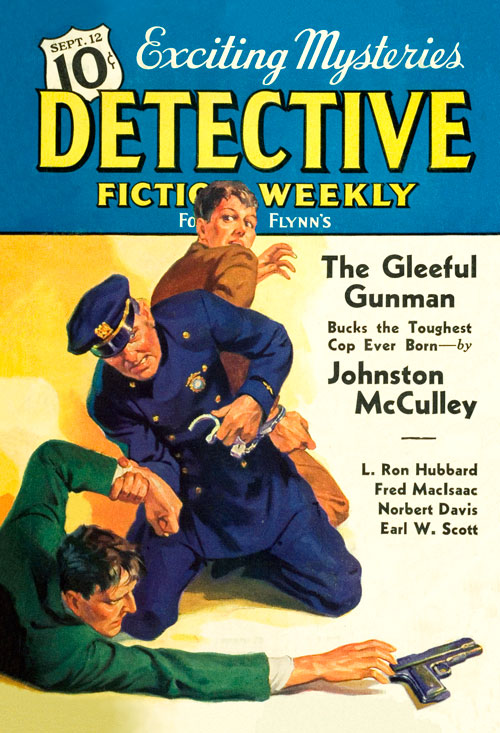
2. “The Slickers” (Detective Fiction Weekly, 1936)
Same month, wildly different ride. Hubbard yanks an old Arizona sheriff named Tex Larimee clean off the range and drops him into New York City to solve a copper baron’s murder. The big-city detectives are sure this drawling cow-country lawman is a hick. He is not. When one of them insists the killing matters because the victim was rich, Tex fires back, “What if he was only worth two bits?” Turns out the territory travels just fine.
Currently available as part of the Stories from the Golden Age series, in the book The Slickers.
3. “The Toughest Ranger” (Western Story Magazine, 1938)
Meet Petey McGuire, the least likely Arizona Ranger you ever saw. He is soft-hearted, jumpy, and easy to laugh at, right up until the shooting starts on a lonely stage road. What Petey learns, and what the story quietly argues, is that the toughest man in the outfit is not the loudest or the fastest. It is the one who keeps his nerve when everyone else loses theirs. An underdog tale with real sand in it.
Currently available as part of the Stories from the Golden Age series, in the book The Toughest Ranger.

4. “Hot Lead Payoff” (Western Story Magazine, 1938)
Here the enemy is not a fast gun but a fat wallet. Cattle baron Martin Graham owns the banks, the land, and half the local officials, and he says so to a young man’s face: “the word of Martin Graham is the law in this country now.” It falls to Tom Nolan to prove that a bought country can still be won back. Money versus grit, and grit gets a vote.

5. “The King of Gunmen” (Western Yarns, 1938)
A range war between sheep and cattle interests has boiled over into hired guns and open killing, and everybody expects the hero to shoot his way to a solution. Instead the story plants its flag on a surprising hill: “the law books has got to triumph.” Even the deadliest hand in the tale would rather see the courts do their job than settle things with a bullet. For a pulp Western, that is a bold thing to say.
Currently available as part of the Stories from the Golden Age series, in the book King of the Gunmen.

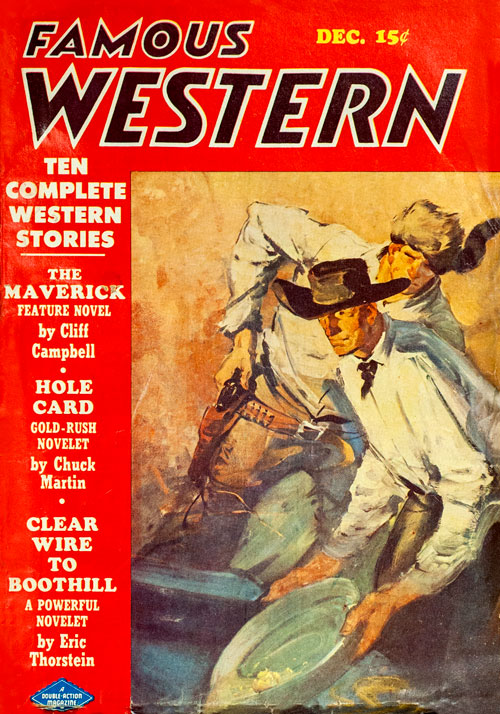
6. “Stacked Bullets” (Famous Western, 1948)
The nastiest villains in the bunch may be the Ringo twins, who quietly buy up every water hole in the Frying Pan Basin and start charging the neighboring ranchers five cents a head just to let their cattle drink. In the desert, whoever owns the water owns everybody. It takes a stubborn rancher named Charley Montgomery, and a town willing to bend the rules, to change that grim arithmetic.
Currently available as part of the Stories from the Golden Age series, in the title The Magic Quirt.
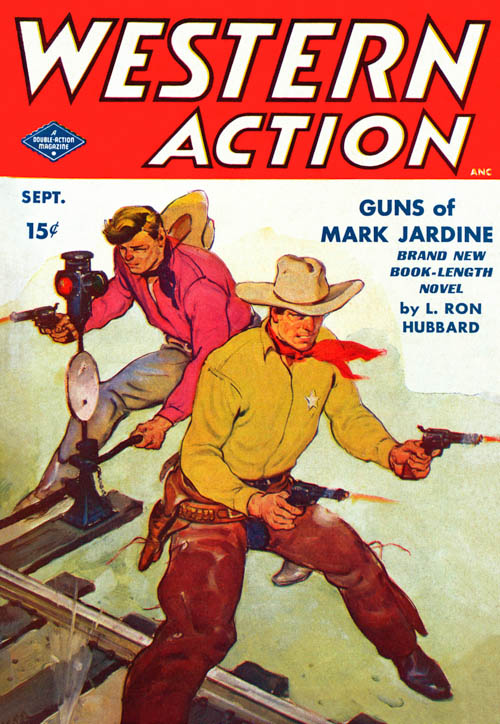
7. “Guns of Mark Jardine” (Western Action, 1949)
The biggest canvas of them all. Mark Jardine crosses “a dry and dusty thousand miles from Texas” and rides straight into a war over ranch empires, mining money, and the roads and rails that string them together. Desert, rivers, mountains, stage holdups, hidden fortunes: if you want the full sweep of Hubbard’s Arizona in one book-length gallop, this is your ride.
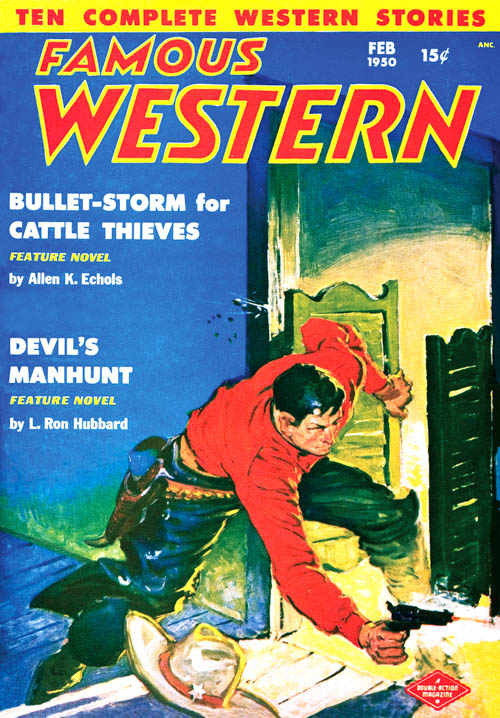
8. “Devil’s Manhunt” (Famous Western, 1950)
Prospector Tim Beckdolt strikes gold, then loses his claim to two thieves who leave him afoot on Desperation Peak, “six thousand square miles of parched Arizona desert” ringed by waterless flats. No posse, no town, no help coming. Just a man, his wits, and a country doing its level best to kill him. This is Hubbard at his leanest and meanest, and it moves like a rockslide.
Currently available as part of the Stories from the Golden Age series, in the book Devil’s Manhunt.
9. “The No-Gun Man” (Thrilling Western, 1950)
Monte Calhoun comes home a trained mining engineer, determined to leave his gunfighting days in the past. Then his father is murdered and the whole town bays for blood. Monte will not shoot a man on suspicion alone, and here is the twist: he is entirely capable of it. His refusal is not weakness. It is a choice, and it may be the most grown-up hero’s arc in the whole nine.
Currently available as part of the Stories from the Golden Age series, in the title The No-Gun Man.

Ride the Whole Trail: All Nine Await
Nine stories, and no two are the same. A sheriff loose in Manhattan. A water war in a bone-dry basin. A prospector running for his life. A gunman who would rather trust a judge. Put them side by side and a pattern rides into view: in Hubbard’s Arizona, the land is never just backdrop. Water, gold, distance, and law are the very things the fights are about, and the people who come out ahead are usually the ones with the sense to respect all four. That is a lot of living packed into nine dime-magazine adventures, and it is a big part of why they still hold up nearly a century on.
Most of these tales are collected in the Stories from the Golden Age series, fast, fun evening reads with the salt and dust left in, while the two longest, “Hot Lead Payoff” and “Guns of Mark Jardine,” are book-length adventures arriving as novels in their own right. Pick a trailhead and ride. You can round up L. Ron Hubbard’s Western adventures here.
Sources & Further Reading
Hubbard, L. Ron. Stories from the Golden Age: Western titles. Hollywood, CA: Galaxy Press. (Collects most of the Arizona tales; the serialized, book-length “Hot Lead Payoff” and “Guns of Mark Jardine” are forthcoming as novels.)
O’Neal, Bill. The Arizona Rangers. Austin, TX: Eakin Press, 1987.
Sheridan, Thomas E. Arizona: A History. Rev. ed. Tucson: University of Arizona Press, 2012.
Widder, William J. Master Storyteller: An Illustrated Tour of the Fiction of L. Ron Hubbard. Los Angeles: Galaxy Press, 2001.
Other articles and resources you may be interested in:
Does Space Opera Influence Our Future?


Leave a Reply
Want to join the discussion?Feel free to contribute!