

Little-Known Facts: Before McCloud, There Was Tex Larimee
“I’m on my way to New York, and I’m here to tell you right now that if any of these greenhorns tries to pull anything on Tex Larimee, they’ll have to talk it over with Judge Colt first.” —Tex Larimee, “The Slickers” (1936)
So begins “The Slickers,” the story at the heart of this edition of our Little-Known Facts series, where we uncover fascinating moments from L. Ron Hubbard’s fiction that reveal unexpected connections to popular culture and the history of storytelling.
How a 1936 Sheriff Rode into New York Decades Before Television’s Most Famous Western Lawman
For millions of television viewers, Sam McCloud was the unforgettable Western lawman who brought frontier instincts to the streets of New York City. Riding into Manhattan in cowboy boots and a Stetson, the New Mexico deputy marshal solved crimes with common sense, quiet confidence, and the experience of a man who had spent his life on the frontier.
But more than three decades before television audiences first met Sam McCloud, readers had already met another Western sheriff under remarkably similar circumstances.
His Name Was Tex Larimee
Readers first encountered Tex in the September 1936 issue of Detective Fiction Weekly, in L. Ron Hubbard’s short story “The Slickers.” Sheriff of Cactus County, Arizona, Tex boards a train bound for New York after receiving an urgent message from his old friend John Temple, a wealthy copper magnate who fears for his life.
Within hours of stepping off the train at Pennsylvania Station, Tex has been robbed of his wallet, his sheriff’s badge, and his beloved Colt .45. He’s dismissed by skeptical policemen, locked in the back room of a run-down bar, and by the time he finally reaches John Temple’s hotel room, he finds his friend lying dead in a pool of blood. Before the day is over, Tex himself is under arrest for murder.
It sounds like the opening of a television crime drama.
Except it wasn’t written for television.
It was published in 1936.
Throughout the story, Tex rarely seems flustered. Faced with one bewildering situation after another, his understated response is often the same:
“Beats hell…”
It perfectly captures his calm determination—and his refusal to let New York get the better of him.
Faced with a city that underestimates him at every turn, he relies not on gadgets or modern police methods, but on sharp observation, experience, and the common sense that made him sheriff in the first place.
Does This Combination Sound Familiar?
In 1970, NBC introduced television audiences to McCloud, starring Dennis Weaver as Sam McCloud, a deputy marshal from Taos, New Mexico, assigned to the New York City Police Department.
McCloud was, like Tex Larimee, a Western lawman dropped into the noise, pressure, and procedure of New York City. He was underestimated by urban detectives, questioned by superiors, and often viewed as a relic from another world. Yet time and again, his frontier instincts allowed him to see what others missed.
The resemblance is striking: a Western lawman in New York, surrounded by city police who do not quite know what to make of him, solving crimes through practical experience rather than big-city procedure.
But before McCloud, there was another important stop on the trail.
The Movie in Between: Coogan’s Bluff
Two years before McCloud premiered, Clint Eastwood starred in Coogan’s Bluff, directed by Don Siegel. Eastwood played Walt Coogan, an Arizona deputy sheriff sent to New York City to extradite a fugitive.
Again, the premise turns on the collision between Western directness and urban law enforcement. Coogan is impatient with bureaucracy, skeptical of New York procedure, and determined to handle things his own way.
Film and television history generally traces McCloud back to Coogan’s Bluff. That connection is well established. The earlier appearance of Tex Larimee in “The Slickers” simply extends the timeline in an interesting way.
The Timeline
1936: In “The Slickers” Sheriff Tex Larimee travels from Arizona to New York and becomes caught in murder, robbery, and an elaborate frame-up.
1968: In Coogan’s Bluff Arizona deputy sheriff Walt Coogan arrives in New York to return a fugitive.
1970: In the McCloud TV series Deputy Marshal Sam McCloud brings Western instincts to the New York City Police Department.
(There is no documented evidence that the creators of Coogan’s Bluff or McCloud were aware of Hubbard’s 1936 story, and no such claim is made here.)
More than three decades before television audiences watched a Western lawman navigate the streets of New York, readers were already following Sheriff Tex Larimee through those same urban canyons.
Whether coincidence, parallel thinking, or simply a timeless premise, it is a remarkable piece of storytelling history.
Why L. Ron Hubbard Could Write Both Worlds
Why does “The Slickers” feel authentic in both Arizona and New York?
Because Hubbard knew both worlds firsthand.
Like Tex Larimee, Hubbard knew the language, humor, values, and wide-open spaces of the American West. Later, New York became the center of his flourishing writing career during the golden age of the pulp magazines.
That firsthand experience gave him a rare perspective. He could write the West without turning it into costume, and he could write New York without treating it as mere scenery. In “The Slickers,” Manhattan becomes a different kind of canyon—crowded, noisy, dangerous, and full of “slickers” who think an Arizona sheriff will be easy prey.
They are wrong.
Tex may not understand New York, but he understands people.
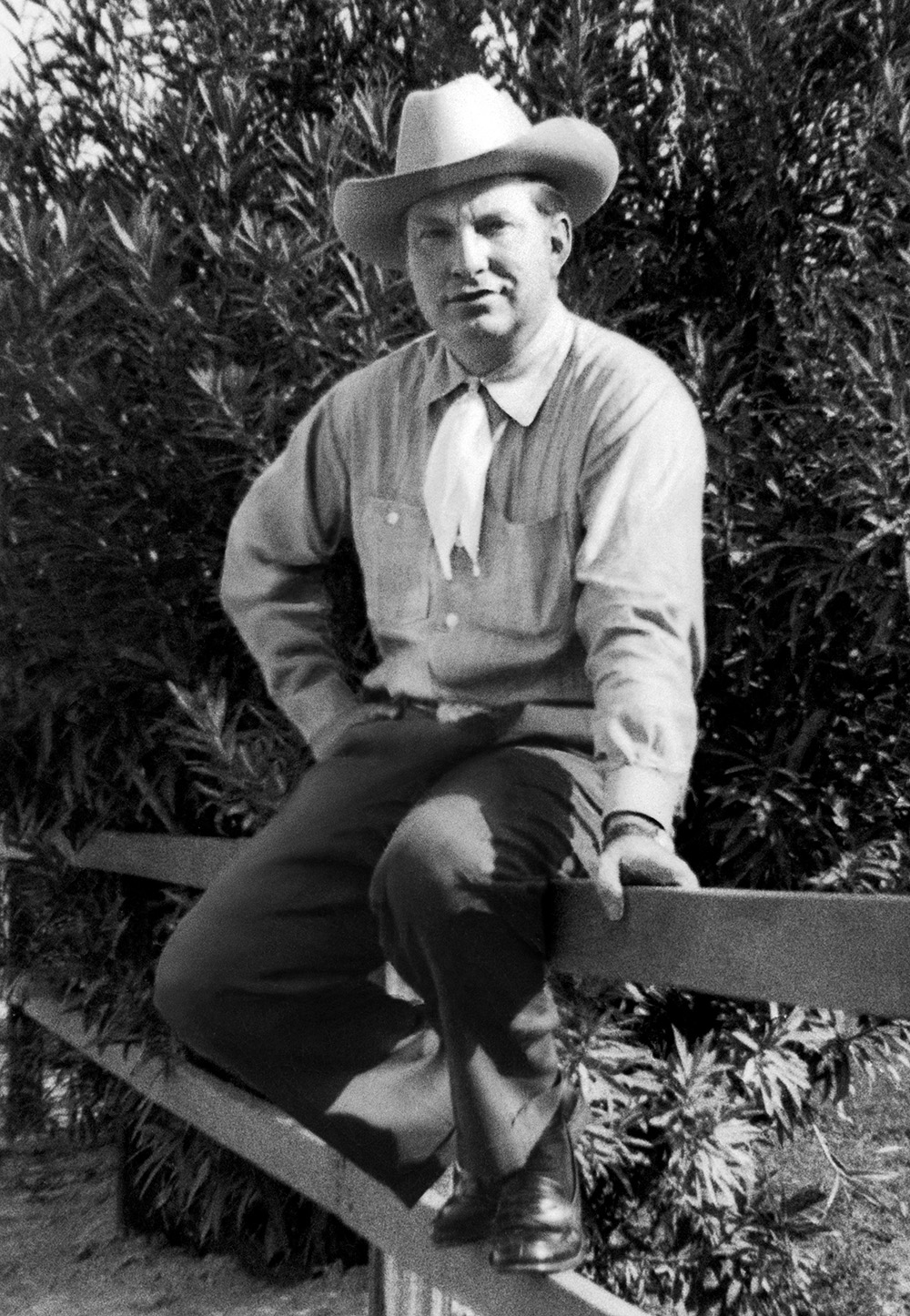
Raised in the American West and later building his writing career in New York, L. Ron Hubbard knew both worlds firsthand.
A Forgotten Sheriff Worth Meeting
Tex Larimee never sets out to teach New York a lesson, he simply refuses to be intimidated by it. And that quiet confidence carries him through every setback until the truth emerges.
As he prepares to leave New York, Tex wrestles his suitcase away from one last would-be thief and mutters:
“More and more I think I like Arizony.”
So the next time you see Sam McCloud ride into New York, you may find yourself thinking of another Western sheriff who made the trip first.
Perhaps it’s time more readers met him.
Postscript: Continue the Adventure
Curious to meet Tex Larimee for yourself?
Listen to an excerpt from the full-cast audiobook of “The Slickers.”
Then continue the adventure in “The Slickers,” which also includes the mystery stories “Murder Afloat” and “Killer Ape.”
 Order the book
 Order the audiobook
 Order the full LRH Western Collection
Other articles and resources you may be interested in:


Leave a Reply
Want to join the discussion?Feel free to contribute!