How the Writers of the Future Volume 42 Audiobook Came to Life
When readers open a book, they bring the story to life in their imagination. When listeners press play on an audiobook, that responsibility falls to the narrators.
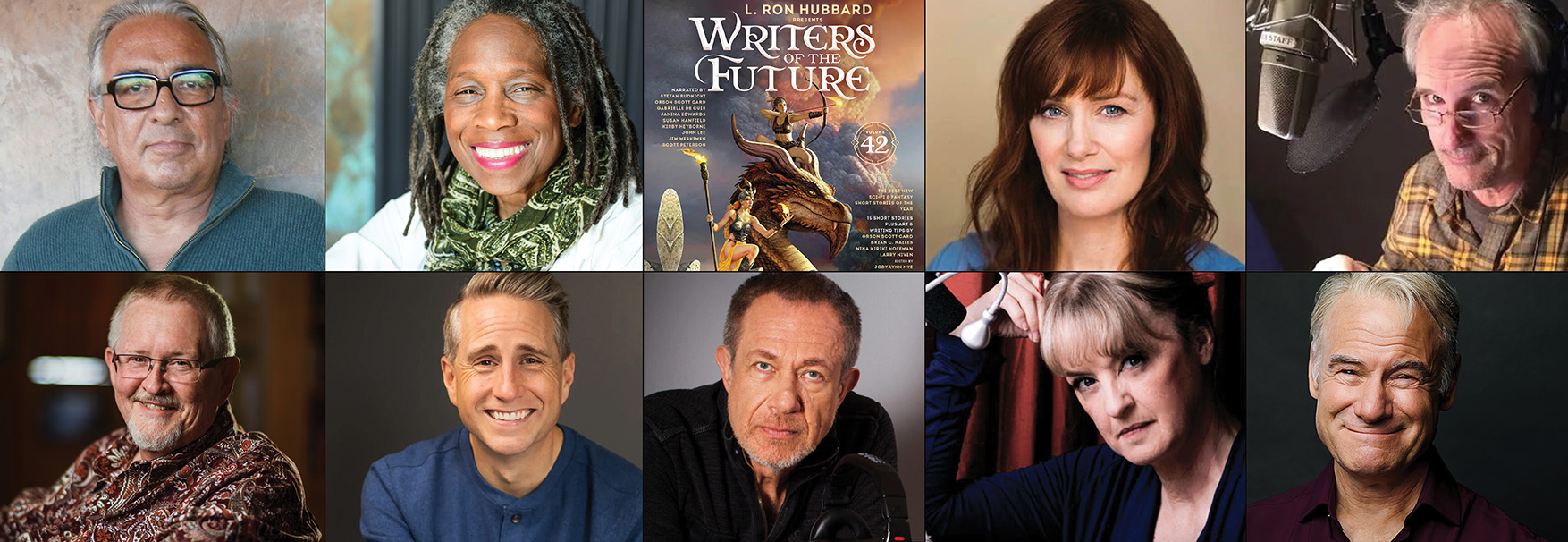
For the newly released L. Ron Hubbard Presents Writers of the Future Volume 42, that task was entrusted to an accomplished cast of audiobook professionals led by two-time Grammy Award-winning producer Stefan Rudnicki of Skyboat Media. Together, they faced a unique challenge: how do you bring fifteen wildly different science fiction and fantasy stories to life while preserving the distinctive voices of the authors who created them?
The answer was an audiobook unlike any previous Writers of the Future anthology.
To explore the making of the audiobook, Writers & Illustrators of the Future Podcast host John Goodwin recently sat down with six of the audiobook’s contributors: producer and narrator Stefan Rudnicki, narrators Gabrielle de Cuir, Susan Hanfield, Jim Meskimen, and Scott Peterson, along with bestselling author and longtime Writers of the Future Contest judge Orson Scott Card, who narrates his own biography on the audiobook.
Their conversation offered a behind-the-scenes look at the creative process, the unique challenges of narrating speculative fiction, and why audio has become such an important part of the Writers of the Future experience.
This year’s collection features winning authors from around the world, including the United States, South Africa, Australia, and the United Kingdom. Rather than standardizing every story into a single style of narration, the production embraced the international nature of the Contest itself. Stories were performed in the dialects and accents in which they were written, creating a richer and more authentic listening experience.
Before elaborating on the audiobook production and the value of short stories, take a moment to sample all fifteen stories in Volume 42—twelve stories by contest winners, two by judges, and one by the contest founder, L. Ron Hubbard.
Hear the Voices of the Future
The sampler features excerpts from each story accompanied by the illustrations created for the anthology, offering a glimpse into the worlds, characters, and imagination that make Volume 42 one of the most diverse collections in the Contest’s history.
Listen to the Full Podcast Conversation
The audiobook sampler offers a taste of the stories themselves. For a behind-the-scenes look at the production of Writers of the Future Volume 42, listen to the complete podcast interview with producer Stefan Rudnicki, members of the audiobook cast, and bestselling author Orson Scott Card.
Together they discuss the unique challenges of narrating science fiction and fantasy, the creative opportunities presented by short fiction, and the international scope of this year’s anthology.
Bringing Authentic Voices to the Stories
For producer Stefan Rudnicki, authenticity was one of the project’s defining goals.
Over a career that has earned multiple Grammy Awards and hundreds of audiobook credits, Rudnicki has worked with stories spanning countless cultures, time periods, and voices. The international nature of Writers of the Future made this project particularly exciting.
“The most interesting and exciting thing is the variety of the stories,” Rudnicki explained. “Because of its worldwide reach, you’re able to work among so many different people, and material that comes from so many backgrounds.”
That variety extends beyond the stories themselves. Each narrator was tasked with preserving the cultural identity of the author while bringing entirely new worlds to life.
Why Short Fiction Is Perfect for Audio
While novels often receive the spotlight, many audiobook professionals have a special affection for short fiction.
Narrator Gabrielle de Cuir, whose extensive audiobook career spans hundreds of titles, believes short stories offer something unique.
A short story must accomplish in minutes what a novel has hundreds of pages to achieve. It must establish a world, introduce memorable characters, create conflict, and deliver a satisfying conclusion—all while leaving a lasting impression on the reader.
“To be able to work with these writers who can compress that down into just a slice of time and have it be so intense,” de Cuir said, “that’s what I found so attractive about being in this anthology.”
Narrator Susan Hanfield found herself equally drawn to the creative challenges presented by the stories she performed.
One story required her to portray characters at multiple ages across an entire lifetime. Another demanded the creation of voices that existed somewhere between human and machine. For Hanfield, these challenges are part of what makes science fiction and fantasy such rewarding genres to perform.
“These writers just invite you into this world where anything can exist,” she said.
More Than Reading Words
For bestselling author and longtime Writers of the Future Contest judge Orson Scott Card, audiobooks represent something much deeper than simply reading words aloud.
Card has worked with Rudnicki for decades and credits him with helping redefine how he thinks about narration.
Rather than delivering lines as a performance, Rudnicki encourages narrators to speak as though they are sitting beside the listener, sharing a story directly into their ear.
The result, according to Card, is a listening experience that allows stories to fully come alive.
“I don’t feel like my books are alive until really good readers have performed them,” Card said.
That sentiment helps explain why audiobook production has become such an important part of the Writers of the Future experience. The anthology not only introduces readers to tomorrow’s leading writers—it allows listeners to hear those stories interpreted by some of today’s most accomplished narrators.
A Celebration of New Voices
The annual Writers of the Future awards gala serves as the culmination of the Contest year, bringing together winning writers and illustrators from around the globe for a week-long workshop and celebration in Hollywood.
This year marked a significant milestone. With the publication of Volume 42, more than 1,000 writers and illustrators have now been published through the Contest since its inception in 1983.
For many attendees, the atmosphere is unlike anything else in publishing.
Hanfield described the evening as one filled with generosity, encouragement, and genuine joy for the success of others.
Others echoed that sentiment, noting that the Contest has created a rare environment where emerging artists are celebrated rather than intimidated, mentored rather than dismissed.
That spirit has become one of the hallmarks of the program over the past four decades.
Why Science Fiction and Fantasy Matter
The podcast discussion eventually turned to the genre itself.
Why do science fiction and fantasy continue to capture imaginations generation after generation?
For some, the answer is possibility.
For others, it is discovery.
Science fiction allows writers to ask difficult questions about society, technology, and humanity by placing them in unfamiliar settings. Fantasy allows readers to explore timeless truths through myth, wonder, and imagination.
Orson Scott Card offered another perspective.
Unlike genres that often rely on familiar formulas, science fiction continually reinvents itself. Every new generation of writers brings fresh ideas, new questions, and different visions of the future.
That process is precisely what the Writers of the Future Contest and anthology were designed to encourage.
Every year, new writers arrive with stories no one has seen before. Every year, new illustrators visualize worlds that have never existed. And every year, readers and listeners are given a glimpse of where speculative fiction may go next.
Experience Volume 42
Whether you prefer reading or listening, L. Ron Hubbard Presents Writers of the Future Volume 42 offers an introduction to some of the most promising new voices in science fiction and fantasy today.
The audiobook edition adds another dimension to those stories through performances that capture not only the words on the page but also the personalities, cultures, and imagination behind them.
By preserving the accents, rhythms, and voices of an international field of writers, the production reflects the truly global nature of today’s science fiction and fantasy community.
Listen to the Writers of the Future Volume 42 audiobook sampler. Discover why the Writers and Illustrators of the Future Contests have remained some of the most influential launching pads for new writers and illustrators for more than four decades—and why Volume 42 may be its most international audiobook production yet.
Cast Listing
Stefan Rudnicki narrated “Artistic Presentation” by L. Ron Hubbard, “Shell Game” by Zach Poulter, “Skinny-Shins” by Orson Scott Card, “The Creator’s Journey” by Brian C. Hailes, “In Living Color” by Michael Kuester, and “A Girl and Her Dragon: A Life in Four Parts” by Joseph Sidari.
Orson Scott Card read his bio and introduction.
Gabrielle De Cuir narrated Jody Lynn Nye and Echo Chernik’s introductions as well as “Bloom Decay” by Elina Kumra.
Janina Edwards narrated “Thickly” by Dorothy de Kok.
Susan Hanfield narrated “Canary” by Brenda Posey and “A Girl and Her Dragon: A Life in Four Parts” by Joseph Sidari.
Kirby Heyborne narrated “Saffron and Marigolds” by Kathleen Powell, “Dragon Visits” by Nina Kiriki Hoffman and “As Long as You Both Shall Live” by Mike Strickland.
John Lee narrated “The Triceratops Effect” by S.J. Stevenson.
Jim Meskimen narrated “Form 14B—Application for Certification of Consciousness Transfer (Post-Mortem)” by Thomas K. Slee, “Space Can” by L. Ron Hubbard, “Collaboration” by Larry Niven and “Ghost Dog” by Mark McWaters.
Scott Peterson narrated “A Ready-Made Bubble of Light” by Thomas R. Eggenberger.
Other articles and resources you may be interested in:
Exploring Digital Personhood and the Ethics of Cyberpunk Existence
Place, Horror, and Comedy That Kills: Why Your Story Can Only Happen Here


Leave a Reply
Want to join the discussion?Feel free to contribute!