Time Travel, Sci-Fi and the Ozymandias View
Or why things matter even when they don’t
Guest blogger Shaun Stevenson
Exploring the Best New Speculative Fiction in Volume 42
Last year, I alarmed my wife by clambering onto our kitchen table and boogying to a tune that lived only in my head.
Here’s the thing: I’d learned I was a winner of the Writers of the Future Contest, with my story “The Triceratops Effect.”
This had been a fun story to write, and when I started, I thought it was about time travel and dinosaurs and bosses who knew a lot about cost—but bugger all about benefit. And if you spotted the italics, you’ve probably already clocked that I’d got that one wrong.
Time Travel Starts in Our Head
To understand how I missed the point of my own story, I need to slip back to memories of a time when it felt like life was Gatling-gunning lemons at me. Worse, it was doing so just after there’d been a series of unexpected fires in my lemonade factory.
At such times we find odd comforts in odder places. For me, it was stumbling upon a photo taken by the Cassini spacecraft of a pinprick of light as viewed through the rings of Saturn. This was accompanied by an (abbreviated) version of Carl Sagan’s magnificent pale blue dot quote:
“That’s home, a dust mote, suspended in a sunbeam.”
From this, I took the comfort that against a backdrop of thirteen billion years, my cruddy luck was unimportant. In fact, everything I’d ever do or not do? Pointless! Trivial! Not even worthy of aspiring towards irrelevance. After all, my life would barely scatter “an inconsequence of photons,” before they got lost in the immense and unforgiving blackness, stretching beyond our pinprick world.
This remains for me an important perspective, which I sometimes think of as the Ozymandias View, after Percy Shelley’s poem featuring a once-great king named Ozymandias. In this, a traveller describes the “colossal wreck” of an ancient statue inscribed with the words: “Look on my Works, ye Mighty, and despair!” even as: “The lone and level sands stretch far away.” The contrast between the inscription’s mega boast and the all-swallowing desert encapsulates how even empires eventually crumble into amnesiac nothingness.
But it wasn’t until writing “The Triceratops Effect” that a more nuanced appreciation of the Ozymandias View coalesced in my mind.
Story Inspirations and Asteroid Strikes
First, a quick confession. The idea for “The Triceratops Effect” stumbled into my head at about 2 a.m. on a cold walk when, for some reason, all the straight roads had turned to zigzags.
As I wobbled home, I wondered what it would be like to be a time-travelling astronomer, tracing the trajectory of the asteroid that smithereened the dinosaurs. Then, I wondered something else: what would happen if they couldn’t find it?
Incidentally, my confession isn’t that I have an alcohol problem. I can say with total honesty that I’ve no foaming glass in hand (mostly because it’s ridiculously difficult to hold the pen without slopping liquid everywhere!) My confession is just that I don’t naturally create stories to convey a message.
I’m in awe of the many excellent writers who do, including many previous winners of the Writers of the Future. However, the bit of my mind that bashes words onto pages is driven by a “what-if” engine.
In other words, I start with an idea, not a message, and no one is ever more astonished than I am, when a message sometimes pokes out shyly from within the story’s plot.
Lampooning Bureaucracy: Douglas Adams to Terry Pratchett
When I started though, it was with a different aim in mind. I’m a huge fan of speculative fiction that lampoons bureaucracy, by applying it to absurd situations. From the Earth being demolished to create a Hyperspace bypass in Douglas Adams’s Hitchhiker’s Guide to the Galaxy, to Red Dwarf’s Arnold Rimmer obsessing over space corps directives, even though the spaceship’s crew have been dead for three million years—himself included. And Terry Pratchett’s Eric, where demon king Astfgl bombastically composes plans to modernise Hell, complete with a rainbow selection of highlighter pens.
So, when I began “The Triceratops Effect,” I wanted to echo those influences. I figured, if there’s no asteroid to clear the way for humanity to evolve, then something else has to bundle the dinosaurs through the exit marked “extinction”—and officious time-travellers seemed a fun choice. Because, if the project’s run by people more worried about cost than purpose, there’s always the risk they’ll wipe out the future, just to give the spreadsheet numbers a sexier sheen.
The Butterfly Effect and the Ozymandias View
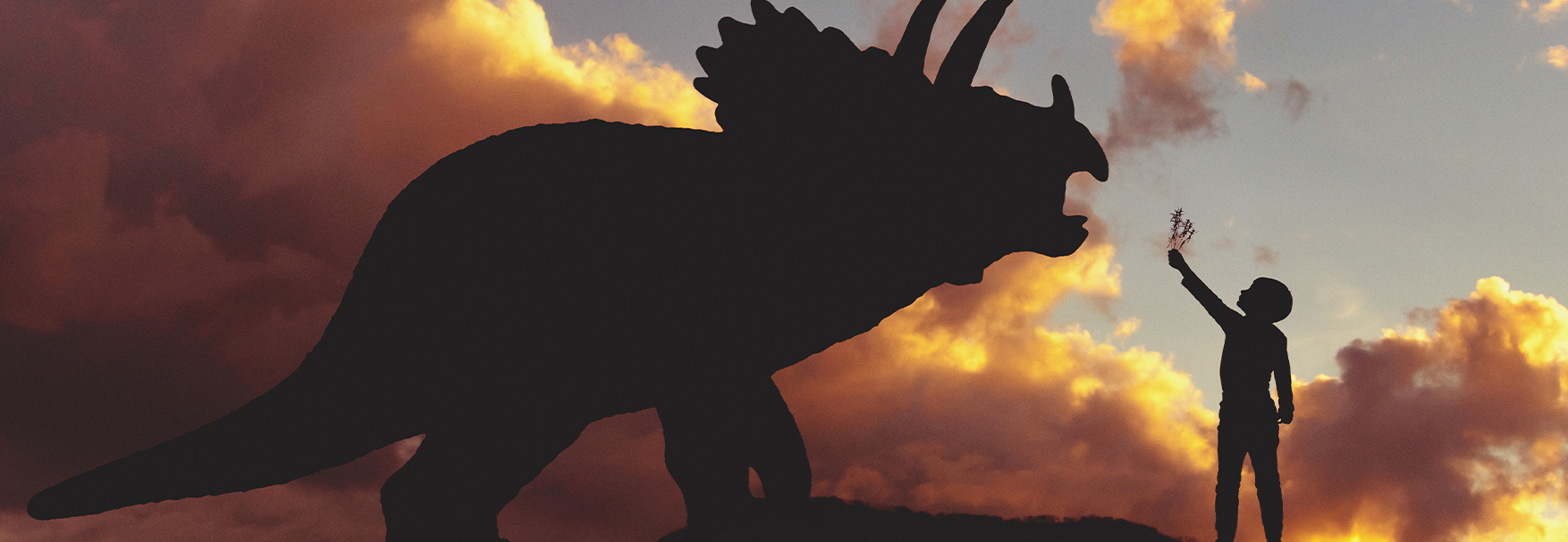
When I lobbed a triceratops called Gary into the mix (thankfully imaginary ones are much easier on the back muscles than the real thing), it was half-whim and half-wink towards Ray Bradbury’s classic short story “A Sound of Thunder.” As Bradbury’s story is often cited as the inspiration for the concept of “the butterfly effect,” it gave me my title too.
But stories are exasperating offspring, and when refusing to do what they’re told, they can grow in unexpected ways. Gary the triceratops became an outlet for my protagonist’s guilt for being complicit in the Cretaceous mass-extinction event, and saving him developed into a core part of my story.
Because having formed an attachment to Gary, my protagonist is confronted with the limits of the Ozymandias View. Once all the dust has settled (all twenty-five trillion metric tons of it), the next sixty-six million years will skedaddle by regardless. As such, is there even any point in trying to save Gary? Does his survival beyond the faked apocalypse even matter?
And the answer, for starters, is that presumably it bloody well matters to Gary.
Saving Infinity, One Triceratops at a Time
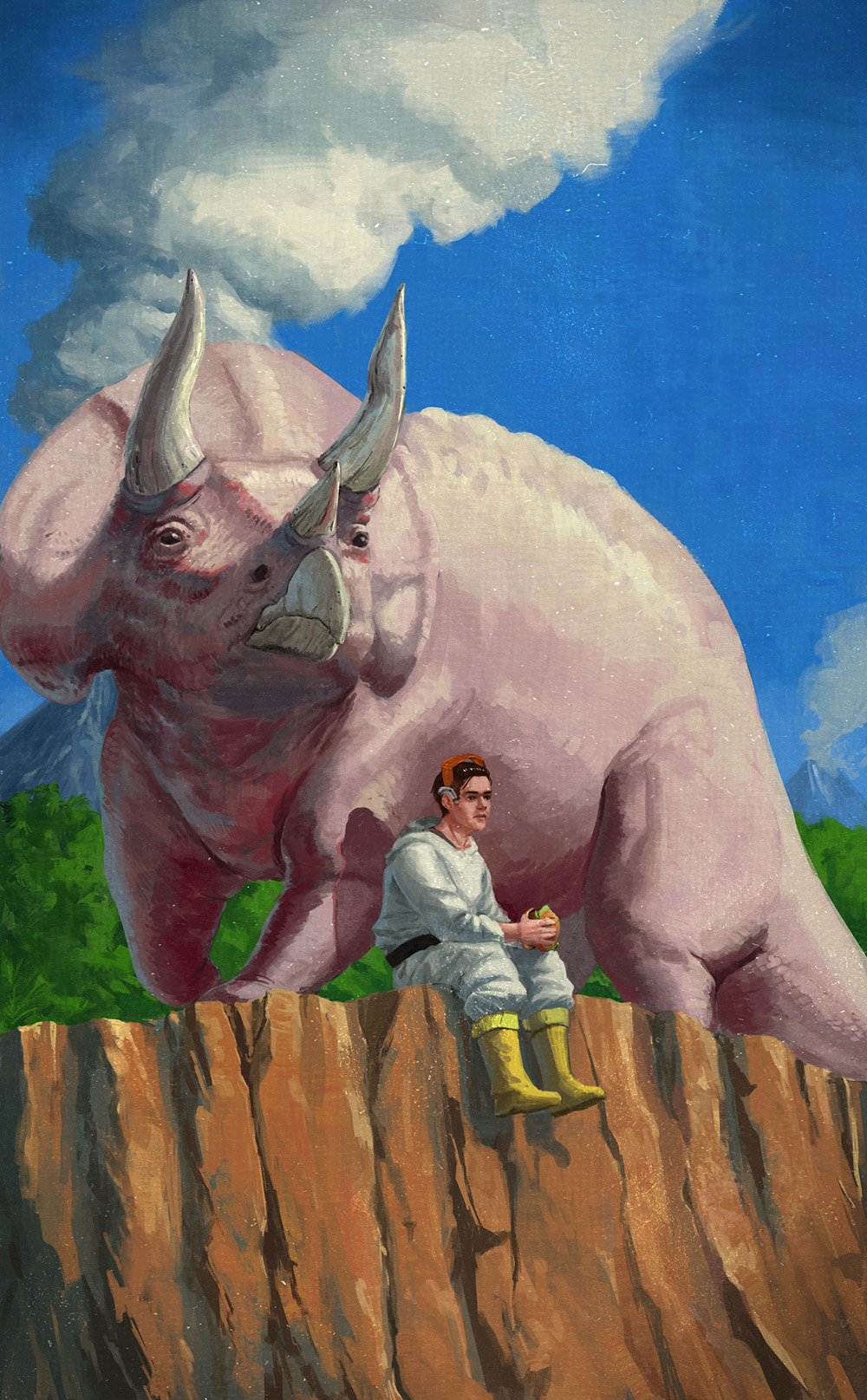
“Triceratops Effect” illustrated by Art Ikuta
I don’t think I’ll ever want to lose the perspective I found in Cassini’s photo of Earth. Given worries that current geopolitical tremors are merely the prelude to more seismic ruptures, there’s a peace in understanding that even apocalypses aren’t forever. Our dust mote world will still twirl about the sun sixty-six million more times, and then dance onwards a few billion more. Meanwhile, the atoms of ourselves will be reshuffled into worm burps and oceans and the bungling brains of other things.
Perhaps, if we’re lucky, a scattering of our fossilised bones will grace the museums of some successor species; no doubt including reconstructions of our appearance, with all the fun details wrong. We’ll be milky-eyed, giant-nostrilled and (hopefully!!) suffer no male pattern baldness. As for humanity’s own peculiar fascination with skin pigmentation? Barely an afterthought.
But regardless, what surprised me after I put down my pen (and mopped up the worst of the spilled beer), was that I’d finally learned that it doesn’t matter that nothing matters. The Ozymandias View never meant no one gets hurt, so it’s not an absolution from the responsibilities we face, individually and collectively, during our own nano-flicker cameo within infinity.
Hardly anyone saves the world—and no one saves it forever—but perhaps all of us should seek to save our own triceratops, should we ever get the chance.
Want to read more about Gary the triceratops? Or stories about those famed dino cousins, dragons? Or tales of body thieves, simulated consciousnesses, or honest-to-goodness classic space battles? Then why not pick up a copy of L. Ron Hubbard Presents Writers of the Future Volume 42—because the best place to see infinity is from your own armchair!

Shaun Stevenson (who monkeys with words under the moniker S.J. Stevenson) is a professional non-professional in the UK civil service, based near Liverpool. He spends most of his working life wondering how he’s mucked up the spreadsheets this time.
Shaun lives with his wife’s kindly suppressed frustration at his growing collection of broken laptops, Star Wars LEGOs, and barely clinging-on zombie houseplants. Sometimes his almost-tame teenagers find him amusing, but generally only by accident.
Shaun has scribbled down stories for as long as he’s been able to clutch a pencil. He likes to think his writing has improved over the years but admits it’s difficult to tell since his handwriting hasn’t. The stories he enjoys writing most tend to be science fantasy, with a pinch of humour for added flavour.
“The Triceratops Effect” hatched from ambling (or at least amber-liquid tinged) thoughts about time-tourists building an observatory to follow the trajectory of the asteroid that wiped the dinosaurs out—and then wondering what would happen if they couldn’t find it.
Any resemblance to social commentary about humanity’s avaricious talent for screwing up entire ecologies is purely coincidental and should probably be written off for tax purposes.
Want to find out more? Then why not take a look at: https://sjstevenson.org/ or find him on https://substack.com/@sjstevenson
Other articles and resources you may be interested in:
Exploring Digital Personhood and the Ethics of Cyberpunk Existence


Leave a Reply
Want to join the discussion?Feel free to contribute!