

Time After Time
Why Time-Travel Stories Captivate Us in Books and Film
Guest blogger Sandra Skalski
Why We Love Time-Travel Stories
Time travel is a common trope in science fiction and fantasy. People love time-travel stories because they contain everything that makes speculative fiction exciting: a journey, uncertainty, danger, and the potential for a happy ending. The moment a character steps out of their own time, an adventure begins. Will they accomplish their goals in the past or future? Will they return to their own timeline?
I love time-travel stories—reading them, watching them, and writing them—because they sweep characters away, test their resolve, and give them the opportunity to discover their heart’s desire.
When Time Travel Goes Off the Rails
Even though they’re fun to enjoy, time-travel stories can easily go off the rails. Plot holes and logical inconsistencies can pull the audience out of the story. You need to believe the character has indeed traveled through time and that achieving their goal is far from guaranteed. If there’s science involved, it must feel believable. In fact, the more science a story uses, the more work needs to be done to keep the logic consistent.
One plot hole that has always bothered me appears in Avengers: Endgame. After Captain America restores the Infinity Stones to their previous timelines, he doesn’t return—he stays in the past to live the life he always wanted. But that raises a question: what happens to everything he did in the “real” timeline? Enter the multiverse, where time splinters and multiple realities exist simultaneously.
Time Travel Begins With a Motivation
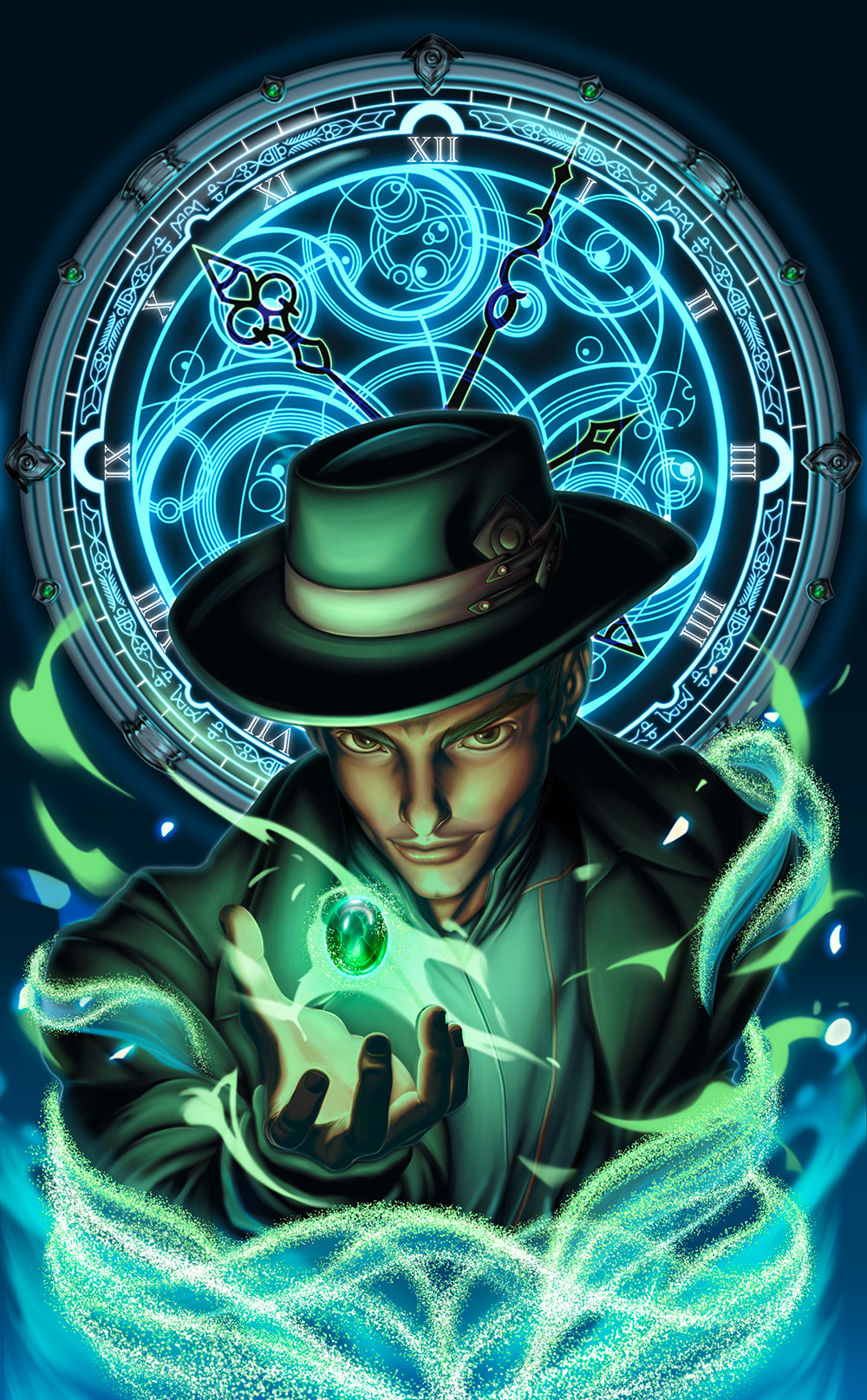
“Slip Stone” illustrated by Haileigh Enriguez
A good time-travel story usually needs three things. First, a character with a reason to embark on a potentially dangerous journey. Many time-travel tales begin with an objective to change something in the past to prevent a terrible future. But the character’s goal doesn’t need to be serious. They may simply want to see a dinosaur or witness a historical event. In Back to the Future, Marty McFly’s eccentric friend asks him to film an experiment—yet as Marty flees from terrorists, he accidentally rides a DeLorean time machine into the past.
In my story “Slip Stone”—which appears in L. Ron Hubbard Presents Writers of the Future Volume 41, an anthology celebrating new voices in science fiction and fantasy—Carlos Buela’s purchase of a green stone gets him caught up with rival gangs of time travelers. His only goal is to return home.
The Many Ways Characters Travel Through Time
You’ve got a character with a goal. Now you need a means of transportation. Will they ride a souped-up sports car or walk through a tunnel? The term “time machine” first appeared in H. G. Wells’s 1895 dystopian novel The Time Machine. But the vehicle doesn’t always have to be mechanical. In Anne McCaffrey’s Dragonflight, Lessa rides a dragon into the past. Doctor Who travels in the familiar TARDIS. In Avengers: Endgame, Tony Stark uses advanced AI to manipulate the quantum realm.
Your choice of time-travel device often determines whether the story feels like science fiction or pure fantasy. Of course, it can be “pretend science” and still work. The flux capacitor in Back to the Future is as imaginary as it gets, but because it sounds science-y, it works. In “Slip Stone,” I use a rare green stone and a future version of a cell phone. It leans more toward fantasy because the focus is on the adventure, not the mechanics.
Every Time-Travel Story Needs Rules
Finally, a good time-travel story needs “the rules.” How does time travel affect the character and the world around them? The rules can be anything you want, as long as they make sense and stay consistent. For example: if the rules say you can’t travel to a time in which you already exist, then your character shouldn’t show up to watch their own birth. Can characters change the past, or are they only spectators?
In Back to the Future, Marty McFly risks altering the past so drastically that he almost prevents his own birth. By the end of the movie, the past does change—but for the better. In Dragonflight, Lessa’s journey into the past solves a problem in her present and explains an ancient mystery.
In “Slip Stone,” I made the rules simple. My characters aren’t using time travel to change terrible events. I imagined that attempts to “save the world” had already happened, resulting in the world as it is now. That allowed me to focus on adventure rather than the expectation that the characters might influence major historical events.
The Butterfly Effect and Big Consequences
If a character’s goal is to prevent something tragic from happening in the future, then it’s a given the future will change. However, an improved future is never guaranteed. In the film The Butterfly Effect, Ashton Kutcher’s character repeatedly tries to change the past to prevent his sweetheart’s death, but each attempt makes things worse.
The term “butterfly effect” was coined by a meteorologist who discovered that tiny changes in his models resulted in massive shifts in predicted weather outcomes. When a butterfly flaps its wings in Brazil, could it cause a hurricane somewhere else? Many credit Ray Bradbury’s 1952 science-fiction classic “A Sound of Thunder” with popularizing the concept. In that story, a time-traveling hunter accidentally kills a butterfly. When he returns to the present, the world is drastically—and disastrously—different.
Why Time-Travel Stories Endure
These examples barely scratch the surface of the many time-travel stories told in print and film. Whether a story aims to change the world or simply change one person’s life, time travel lets us imagine the consequences of every choice.
And if you enjoy time-travel adventures—from classics like The Time Machine to modern multiverse blockbusters—consider exploring Writers of the Future Volume 41, where “Slip Stone” offers its own twist on rival factions, dangerous artifacts, and the struggle to return home.
More Time-Twisting Tales in Volume 41
L. Ron Hubbard Presents Writers of the Future Volume 41 includes several other stories that bend, twist, or tangle time in unexpected ways:
- “Storm Damage” by T.R. Naus—a cerebral sci-fi thriller where time isn’t just a tool … it’s the last line of defense.
- “Blackbird Stone” by Ian Keith—where the enchantment lingers, time is unbound, and love is a choice made again and again.
- “Thirty Minutes, or It’s a Paradox” by Patrick MacPhee—a sharp, absurdist sci-fi romp packed with main character syndrome, paradox time loops, and ’80s and ’90s nostalgia. It’s what happens when your worst enemy … is you.
- “A World of Repetitions” by Seth Atwater—a mind-bending and emotionally resonant journey through looping time, where memory, identity, and free will collide in a search for meaning across infinite iterations.
Together, these stories add even more depth and variety to the time-related themes woven through the anthology.
Will Time Travel Ever Be Real?
Will time travel ever be possible? Personally, I don’t believe so. Yet quantum physics raises many questions about the nature of time and space. Maybe scientists will one day discover the key. Either way, it’s fun to speculate—and even more fun to read stories about the possibilities.
 Sandra Skalski’s love of fantasy ignited when her kindergarten teacher read Ozma of Oz to the class. Growing up, she spent most of her allowance in the Bookmobile. During the summer, she walked nearly two miles to the nearest library to devour every fantasy and science fiction book she could find. She wrote her first sf story when she was thirteen. It wasn’t very good, but she was determined to keep writing. Attending the Viable Paradise workshop helped improve her craft. The first time she got the courage to hit Submit, it was to the Writers of the Future Contest. Her stories have appeared in Factor Four Magazine, Wyld Flash, Ruth and Ann’s Guide to Time Travel Anthology Vol. 2, and 100-Foot Crow.
Sandra lives with her husband in suburban New Jersey. She recently retired from a career in chemical engineering, leaving her with actual time to write. When she’s not writing, you can find her in the butterfly garden or traveling with her husband. Her greatest joy is spending time with her daughter, son-in-law, and her two beautiful grandchildren.
The idea for “Slip Stone” came when she watched H. G. Wells’s The Time Machine and Free Willy, back to back. She always had a feeling that Free Willy wasn’t just about a whale. She wants to write stories that sweep you away on an adventure, without losing sight of what the best stories are about: people.
Other articles and resources you may be interested in:
Leave a Reply
Want to join the discussion?Feel free to contribute!


Science fiction is fiction… until it isn’t.
PS: I’m writing this in 2045.