
 ISBN: 978-1-61986-774-1
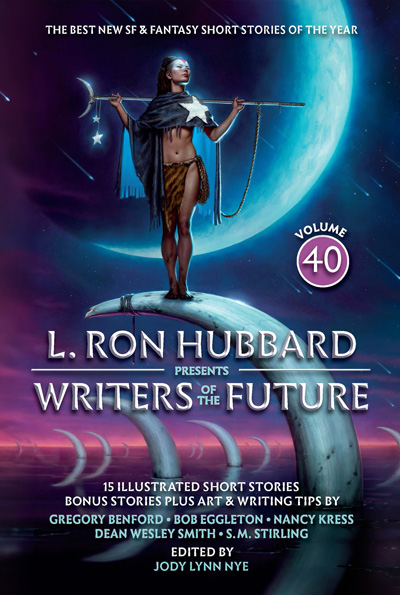
L. Ron Hubbard Presents Writers of the Future Volume 40
Discussion Guide
“The Edge of Where My Light Is Cast”
by Sky McKinnon
When her owner goes missing, a digital housecat must become more than a simulation to find her dearest companion through the virtual world.
- Tabitha is a digital entity that might be considered an “artificial intelligence.” What is the distinction between “artificial life” and
non-sentient code? Is this a line that you can draw? - The internet was once described as an “information superhighway.” How has the digital landscape changed, and how might you describe our relationship to the “online world” today?
- When Tabitha creates a digital incarnation of Ary, what information might she have used as the basis for her personality? Might it be incomplete in some way? Does it have to be identical to be a genuine continuation of her existence?
“Son, Spirit, Snake”
by Jack Nash
No one came to his brother’s funeral. Not even the spirits. Étienne knew it was his fault.
- Major world religions, especially Western ones, often conceive their deities as mysterious, beyond understanding, and high above mortal affairs. How are the spirits in this story similar or different?
- Étienne asked Dieudonné for something made of gold even though he knew his brother’s wealth came from stealing. How do you view this request? Was Étienne right to blame himself for his brother’s death? Why or why not? Did the story’s end change how you view Étienne’s actions?
- Community and tradition are essential to the residents of Deng-Deng. What is your community like? Do you feel connected to the people around you? Why or why not?
“Nonzero”
by Tom Vandermolen
Man overboard is a nightmare scenario for any sailor, but Lieutenant Susan Guidry is also running out of air—and the nearest help is light years away.
- Technically, “nonzero” means a number that isn’t zero. Typically, though, the term is used for numbers that are very, very close to zero. What does “nonzero” mean for the suit’s AI, and what does it mean for Susan? What does it mean to you?
- Faith can be defined as belief in the face of little or no evidence. How much do you think faith rather than probabilities drove Susan’s final decision? Which of her beliefs helped guide her decision? What beliefs do you have that drive your choices?
- When Susan says, “I spent my whole life trying to get out here,” does she mean she squandered or invested her life towards this goal? How are you spending, investing, or saving your own life?
“On Writing and Science Fiction”
by L. Ron Hubbard
An interview with Mr. Hubbard that provides invaluable insight into the art and craft of writing, the role of science fiction in society, and sound advice for aspiring writers everywhere.
- According to Hubbard, science fiction writers played a significant role in shaping public perception and acceptance of space exploration and technology. Do you think science fiction has the power to influence real-world advancements and societal attitudes? Can you imagine any examples of science fiction–inspired scientific or technological developments?
- Hubbard describes his writing process, emphasizing the importance of communication and the ability to see from the reader’s perspective. How do you think his experiences and worldview influence his approach to storytelling? How might aspiring writers benefit from adopting a similar mindset in their writing endeavors?
- When asked to describe himself as a writer, Hubbard emphasizes his love for writing and his ability to become fully immersed in the creative process. How important do you think passion and dedication are for success in any field? Can you relate to Hubbard’s description of being so absorbed in an activity that you forget about time?
- Hubbard offers straightforward advice for budding writers: write, and then write some more. How do you interpret his advice in the context of developing one’s writing skills? Is there value in learning by doing, rather than focusing solely on theoretical knowledge?
- Hubbard discusses the importance of setting goals and following a schedule to achieve productivity in writing. How do you manage your time and stay disciplined when pursuing your goals? Can you relate to Hubbard’s approach to productivity and organization?
“The Last Drop”
by L. Ron Hubbard and
L. Sprague de Camp
Mac wanted to invent a cocktail to burn itself upon the pages of history—but this one had some unexpected side effects.
- Identify instances of humor and irony throughout the narrative and discuss how they contribute to the overall tone and impact of the story.
- Discuss the transformation of O’Brien’s character throughout the story, from a reluctant bartender to a brave hero.
- How does the author incorporate the concept of the square-cube law into the story, particularly concerning the physical changes experienced by the characters? What is the square-cube law?
- Explain how the characters’ smaller size affects their physical abilities, such as agility and speed. How does this aspect contribute to the suspense and action in the story?
- Where is Borneo? Would you like to go there? How different do you think Borneo is from where you are now?
“The Imagalisk”
by Galen Westlake
Dementia has landed Dan Kennedy in Graydon Manor, and what’s left of his life ahead seems dismal, but a pair of impossible visitors bring unexpected hope.
- The sky’s the limit. If you had an IF (Imaginary Friend), what would it be?
- “The Imagalisk” touches on the idea that as we approach our end-of-life cycle, we return to a state of mind we once enjoyed as children. Is it the same, or is it something different entirely? Is there a part of us that we lose as we grow older?
- “The Imagalisk” never definitively answered what happened to Jack, Kate, and the other IFs during the period in which they were forgotten. What do you think happened to them?
- Over 55 million people have dementia, and the number is anticipated to double every five years. What kind of considerations or adjustments should society prepare for this new demographic?
“Life and Death and Love in the Bayou”
by Stephannie Tallent
When a teenage swamp witch fears her mama will be killed, she utilizes her wits and the magic of the bayou—no matter the cost to her own soul.
- Delphine feels she has no option but to murder Leroy Bobanchet. Do you agree with her choice? Why or why not? Do you think she should have reported him for attempted rape if not for the assaults on her mother?
- Delphine’s grandma warns her she must control her powers, noting that Miss Calixte overcome by her own power became a part of the bayou and no longer quite human. Delphine thinks that isn’t necessarily a bad thing. Do you think Delphine may end up like Calixte because of the burden of Bobanchet’s death?
- The initial languorous pacing and meandering of the story echoes the ebbs and flows of the bayou, drawing you in. What other storytelling devices do you notice? What about Delphine, and how are her vocabulary and sentence structure occasionally at odds with her self-educated background?
“Five Days Until Sunset”
by Lance Robinson
Our exodus family awoke on the new world—a paradise inexplicably teeming with Earth life, the Promise fulfilled. But 154 of us are missing.…
- By the middle of the fourth scene, Bering and the other colonists begin to grasp the implications of his discovery and understand what they must do to survive on Epsindi Ta. Why is it so tricky for Bering and most of the others to accept the reality that is staring them in the face?
- Bering admires Ford Cyltemstra, whose faith is strong and apparently unshakeable. Faith is also important to who Bering is. How does faith manifest differently in each of them?
- What role does faith play in Bering’s decision in the final scene? What role does reason play?
- What do you think happens to those colonists who stayed behind when Bering, Jaykella, and the others in their group leave to begin their perpetual journey following the sun?
“Forty Years of Writers of the Future”
by Gregory Benford
Benford reflects on the SF giants of his youth and the societal changes in the last forty years and provides some advice to aspiring writers.
- Benford shares anecdotes about interacting with legendary authors like
E. van Vogt and Algis Budrys. What do you think aspiring writers can learn from these encounters? How might hearing stories from experienced authors impact the confidence and approach of emerging writers? - Benford discusses the importance of developing a thick skin against unimportant criticism while prioritizing the connection with readers. How do you think this balance between critique and validation applies to other creative endeavors beyond writing?
- Benford describes science fiction as the most inherently hopeful genre of literature. Do you agree with this assessment? How do science fiction narratives shape our understanding of the future and our place in the world?
- The author reflects on the progress humanity has made, from technological advancements to quality of life. How does Benford’s perspective on the world’s achievements influence his outlook for the future? Do you share his optimism about our ability to create a better world for future generations?
- Benford emphasizes the importance of imagination and creativity in shaping the future. How do creativity and storytelling contribute to social progress and cultural evolution? Can you imagine any examples of fiction inspiring real-world change or innovation?
“It Seemed Like Just Yesterday”
by Dean Wesley Smith
Dean shares his professional journey since winning the Writers’ Contest forty years ago.
- How does Dean Wesley Smith describe his experience attending the Writers of the Future award ceremony at Chasen’s Restaurant? Can you imagine yourself in a similar situation? What would it feel like to be surrounded by established science fiction and fantasy authors?
- Smith shares a personal setback when his house burned down shortly after the awards ceremony. How do you think this event influenced his writing journey? Can you imagine any instances where adversity has sparked personal or creative growth?
- Smith acknowledges the mentorship and support he received from Algis Budrys and Jack Williamson, who believed in him from the beginning. How important do you think mentorship is for emerging writers? Have you ever had a mentor who significantly influenced your personal or professional development?
- Smith concludes by remarking that parts of his journey seem like they were just yesterday. How do you think certain experiences have a lasting impact on our lives, even as time passes and circumstances change?
“Shaman Dreams”
by S.M. Stirling
Spirits were supposed to lurk beneath the Lake of Death, hungry and patient and hostile to all life.
- Discuss the cultural significance of rituals, dances, and songs in the Real People’s society. How do these practices connect individuals to their ancestral spirits and the natural world?
- Consider the implications of environmental changes, such as the scarcity of mammoths, on the Real People’s hunting and gathering practices. How do they adapt to these changes to ensure their survival?
- Explore the significance of spirit-walking and communication with ancestral spirits in the Real People’s culture. How do these spiritual practices shape the characters’ understanding of the world and their place within it?
- Reflect on resolving the conflict and Sees-Much-Everywhere’s ultimate sacrifice. How does her act of defiance against the Horned Men ensure the safety of her people, and what does her final journey symbolize in terms of spiritual belief and transcendence?
“The Wall Isn’t a Circle”
by Rosalyn Robilliard
A new app lets users see through the eyes of any human in history, but it’s not long before the secrets of the past catch up with the present.
- If you could look through the eyes of anyone else in the world, who would you choose? And why? What might you learn?
- At the start of the story, MindWeb is only historical. If such technology were possible, would it be morally right to look through the eyes of only historical people? Would it be different if they were from 200 or even 500 years ago? How would you feel if you knew people in the future could look through your eyes?
- How do you think Macy’s life has been defined by her relationship with her sister? Do you think siblings have a bond that is different from other relationships?
- Hattie feels guilty at the end of the story. Do you think she’s right to blame herself for what happened to Macy? What might you have done differently in Hattie’s shoes?
- As technology progresses, our personal data becomes more valuable and widely used. Do you think we’re moving too fast? Do you care if others can access your personal data?
“Da-ko-ta”
by Amir Agoora
In the shadows of Teddy Roosevelt’s wendigo hunt, a Native American boy resolves to turn the tables on his captors, setting his sights on the ultimate prey—America’s Great Chief.
- Language and culture play a noteworthy role in the text, from the title to the characters’ references to the works of Dante, Plutarch, and Thucydides. Why is language important to the protagonist? To Roosevelt? Why does the language one speaks matter at all?
- Choose a scene from the story where you realize there is more to this world than meets the eye. How do the elements of magical realism add to or detract from the political or historical themes of the narrative?
- The themes of empire and conquest play a prominent role, from the Tarnished’s and wendigo’s bloodlust to Roosevelt and the protagonist’s ideals. What parallels from the story can be drawn to today, around the world, or where you live?
- The wendigo, across many Native American cultures, has connections to greed, excessive consumption, and colonialism. The main character often compares the president to the wendigo. Is this a fair comparison? In what ways might Roosevelt embody the indigenous conception of the wendigo?
“Squiddy”
by John Eric Schleicher
When squids from outer space take over, a punk-rock PI must crawl out of her miserable existence to find her client’s daughter—and maybe a way out.
- Drawn to its wet climate, Jocelyn migrated to the Olympic Peninsula from Las Vegas, her narrative noting that Las Vegas is now a “dying dry cough of its once spectacular form.” What comparisons can you draw between the fictional Las Vegas in “Squiddy” and any factual ancient civilization well-known today?
- When we meet Jocelyn, she predicts she has a year or two left before she dies. Why is she so pessimistic about how long she will live? Which of her skills and characteristics have helped her stay alive so far? Do you think she’d give a similar prediction about her life expectancy if asked at the end of the story? Why or why not?
- After being threatened in her apartment, Jocelyn plans to flee far from Boyd immediately. She doesn’t. Why does she change her plans?
“L. Ron Hubbard’s Illustrators of the Future at Thirty-Five!”
by Bob Eggleton
Renowned artist Eggleton reflects on the genuinely fantastic talent that has emerged through the Contest and provides insight into his ability to illustrate.
- Bob Eggleton discusses changes in the science fiction and fantasy genre over the years, particularly in publishing and illustration styles. What are your thoughts on these changes? Do you prefer the aesthetics of earlier science fiction art or contemporary styles?
- Eggleton emphasizes the importance of nurturing talent, regardless of the medium used for creation. How do you think talent and skill development have changed with technological advancements, such as digital art tools? Are there any traditional methods or techniques you believe are essential for artists to learn, regardless of technological advancements?
- The article quotes L. Ron Hubbard, stating that “The artist is looked upon to start things . . . and give tomorrow a new form.” How do you interpret this statement? In what ways do you believe artists contribute to shaping culture and society?
- Eggleton expresses optimism about the future of the Illustrators of the Future Contest under the current Coordinating Judge. What do you think the future holds for aspiring illustrators and artists? How might contests and platforms like this evolve in the coming years?
“Halo”
by Nancy Kress
Another outbreak? This time it’s a virus with an eighty percent infection rate that effects personality changes … permanently.
- Put yourself in Susan’s shoes. How would you navigate her challenges, balancing professional obligations with personal convictions and ethical principles?
- Consider the ethical implications of conducting medical investigations based on political favors rather than scientific necessity. How might this compromise the integrity of public health institutions?
- Analyze Lucas’s motivations for spreading the virus and Susan’s for confronting him. How do their personal histories and beliefs influence their actions?
- Discuss the broader theme of societal control and manipulation. How does the story explore the ethical boundaries of using pathogens to influence human behavior, and what are the potential consequences of such manipulation?
- Consider the consequences of Lucas’s actions and Susan’s involvement in the aftermath. How do their choices impact public health, global security, and individual lives? Is this for the better or worse?
“Ashes to Ashes, Blood to Carbonfiber”
by James Davies
Planet K2-18b is almost dead, humanity is enslaved, and it’s Rickard’s fault. Now in his twilight years, he’d give an arm and a leg for redemption. Literally.
- Rickard blames himself for his wife’s death. Do you think he is at fault? Have you ever blamed yourself for something that might not have been your fault?
- If you had a fabricator, what would you print? What would you sacrifice?
- Why do you think the ultra-rich Billionth kept the twenty billion common folk alive?
- Was Rickard’s plan of fleeing to the cave cowardly? Would you have fought the Billionth in another way?
“Summer of Thirty Years”
by Lisa Silverthorne
What if magic could do the unthinkable, and undo Death itself? Would you use it no matter the cost? What would you sacrifice for love?
- How do Mimi and Mark repay Brandon’s loyalty? Would you have done the same thing for your best friend? Why or why not?
- For many summers, Brandon has been hiding his illness to protect his best friends from the truth about his growing difficulties. If you faced a similar situation, would you tell your friends the truth or keep it quiet? Why or why not?
- If you knew the exact day you were going to die, how would you spend that final day? Who and what would you miss most and why?
- Do you think love survives death? Why or why not?
“Butter Side Down”
by Kal M
Joe is a prospector tasked with exploring the cosmos on behalf of an all-powerful government. Breadna is a toaster. There have been weirder love stories, but that’s unlikely.
- Kevin calls Breadna a flawed AI because she behaves like a human. Captain Crab calls Joe a liability. Is humanity a flaw? Would we be better off if we behaved more like the other species in this fictional universe? Would the other species be better off if they behaved like us?
- Does Joe really represent the average human? How much of yourself do you see in him?
- Joe could have turned Breadna in at any point once he found out she was Malgroth. He didn’t. In fact, he was prepared to go to his death. Was that the right decision? Is he a hero for protecting his friend or a fool for throwing his life away for a rogue, planet-destroying AI?
- Is Breadna alive?