
 ISBN: 978-1-61986-768-0
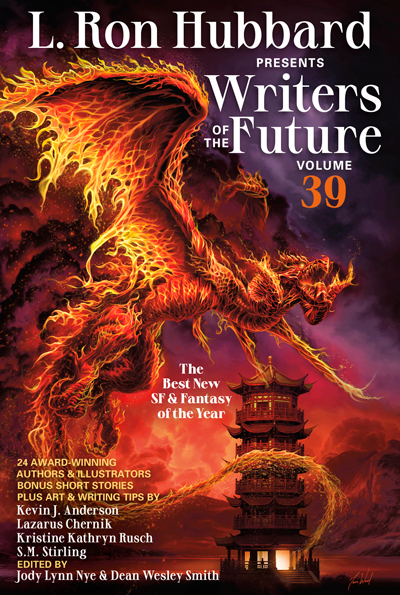
L. Ron Hubbard Presents Writers of the Future Volume 39
Discussion Guide
“Kitsune”
by Devon Bohm
A miracle? An omen? Or something else? One day, they arrived in droves—the foxes of the desert, the field, the imagination.…
- Reyna is fascinated with not only the art, but the life of Georgia O’Keefe as a feminist and visionary. She particularly identifies with the quote: “It is only by selection, by elimination, and by emphasis that we get at the real meaning of things.” How does this quote connect with the characters in the story? What does this quote mean to you?
- If mythology can be defined as stories different cultures tell to get at the truth of the human experience, what does the transformative nature of the legend of the Japanese kitsune tell us about the embodied female experience?
- While the rest of the female characters in the story transform literally, any change in Reyna is more subtle, with the conclusion remaining open-ended. What do you think happens after Reyna disappears from the page? What do you want to happen and why?
“Moonlight and Funk”
by Marianne Xenos
When a vampire, a dragon, and a shape-shifting Chihuahua meet on a beach in Key West, fireworks go off! But that’s just the background.
- Tann’s appearance changes when it talks to some people. What do those changes in appearance reflect?
- Why does Aveen choose not to drink the treasure thief’s blood?
- Why is it hard for Aveen to accept Tann’s offer? What does she have to give up? What does she gain?
- How long has Aveen been alive? How do you think time has affected her? How do you think her experience with slavery affects her decisions?
- What do you think will happen at the end? If Aveen lives, what do you hope will happen next?
“Death and the Taxman”
by David Hankins
The Grim Reaper, trapped in an IRS agent’s dying body, must regain his powers before he dies and faces judgment for his original sin.
- We often judge people by singular actions we see as wrong. At what point did Grim begin questioning his assumptions about Frank?
- If someone wronged you, what would change your negative assumptions about them? Why?
- There is an age-old adage: let the punishment fit the crime. After Grim’s original sin, did he really sidestep Judgment by becoming the Reaper? How might alternatives to one-size-fits-all justice benefit both the perpetrator and the victim? Give examples.
- Alvin noted four incessant needs for human survival and one need for species survival. What other human needs did Grim discover? How did having those needs met change him?
- Grim stated, “Everybody leaves loved ones behind. We all have unfinished business.” What is your unfinished business? How have you let your loved ones know that they are loved?
“Under My Cypresses”
by Jason Palmatier
In a metaverse future, a woman who exposes falseness in others must decide what is real to her—the love she lost or the love she may have found.
- How did your feelings about Lin’s night out change after Nan left her outside the club? Did you feel the same as Lin? Were you unfazed?
- What are your personal limits in calling something “real”? Is a session of Minecraft with friends “real”? What about playing cards at their house over pizza? What about playing cards online while everyone is in their own home? Were the online games “real” card games?
- How does the fight to pass the Visibility Bill mirror struggles in our own time? Is Lin’s reaction to it justified? Would you accept the mandates of the Visibility Bill if you were in Lin’s position?
- Would you make the same choice as Lin at the end? Why or why not?
“The Unwilling Hero”
by L. Ron Hubbard
Vic Harden wasn’t lured by glory on a daring mission into the reaches of outer space—he was ordered out there by his editor.
- Vic Hardin was ordered on a mission to find Whitlow. If you lived in a time when this type of space travel were possible, how would you respond to such a command?
- While Vic Hardin is out in space, he continues to write even though the speed of communication is such that it won’t be read for many years to come. Why do you think he was writing? And what would you write about?
- Hardin made up a game of tag with the SOS message in order to locate Whitlow. How would you describe his system?
- Do you believe other planets will support human life? Do you believe there are alien races? Why or why not?
- What awaits us in outer space?
“White Elephant”
by David Henrickson
Dangerous opportunities present themselves when an alien ship arrives in the solar system seeking repairs.
- Given the advanced technology the Cenanti are prepared to share in exchange for humanity’s help, what changes would you expect to see in human society in the following generations? What would future visits by the Cenanti look like?
- As part of their life cycle, the Cenanti transition between a terrestrial form for breeding and a motile form that scatters on the wind. How did that affect the development of their civilization? How do they differ psychologically from humans?
- The Cenanti arrive just as humanity is beginning to truly colonize the solar system. How would the alien’s advanced technology affect that colonization and the relations between the various colonies?
“Piracy for Beginners”
by J.R. Johnson
With her spaceship at the wrong end of a pirate’s guns, a former war hero must face down her enemies and demons to save Earth’s last best chance for peace.
- What is the role of humor in communicating serious concepts in fiction?
- What themes of leadership, responsibility, and ethical behavior do you see in this story? For example, when the captain decided to take over the new ship despite the fact that it was a legal grey area, do you think she made the right decision?
- What roles do you predict for corporations, governments, and law enforcement in a space-faring future?
- The captain makes a point of saying that she was acting in the best interests of her passengers and crew. Do you think she did the right things in order to keep them safe? What other courses of action could she have taken?
- Are there “good” pirates? Why would the captain aspire to be one?
“Fire in the Hole”
by Kevin J. Anderson
Dan Shamble, Zombie P.I., faces one of his funniest and most perplexing cases ever—an enlightened ogre, a salamander with low self-esteem, and a raging fire dragon terrorizing the Unnatural Quarter!
- What values and purposes exist in reading or writing a silly story? What is a sense of humor and why do you think different people find different things humorous? Do you recall specific instances when you genuinely found something funny that someone else did not? What can you do in such a situation?
- “When you reach a certain stage of enlightenment, you no longer need vowels in your name.” Should you reach such a stage of enlightenment, how would you pronounce your name and the names of those around you? And at the next stage “you don’t even use consonants.” How would your name sound then?
- Syl finds his inner spirit, which is represented in a very unexpected way. How would your inner spirit be manifested within the confines of this story?
“A Trickle in History”
by Elaine Midcoh
Years after the Second Holocaust, the last surviving Jews on earth attempt to rewrite the past.
- Rebecca was thirteen when she was first told about her Jewish heritage. Afterward, Albert said, “You can betray us if you wish or you can take up your heritage.” Since Rebecca would certainly have been arrested/killed if she told anyone about being Jewish, what did Albert mean by the word, “betray”—what sort of betrayal was he talking about? Would you have told your child about her “heritage,” or would you want her to “pass” and live without fear? If you were Rebecca, would you want to know or not know?
- Is time travel ethical? Rebecca and her group want to go back in time to prevent terrible wrongs. But, while some people might be saved in a changed world, others might never be born. And what else might the group cause by changing history? Perhaps because of their actions World War II is merely delayed and starts later—possibly when many countries already have nuclear bombs! Is it right to go back in time to benefit yourself or your group, knowing that your actions might cause great harm to others?
- What did you think of the scene with Augie and his roommate/friend? Were you surprised to see perhaps the most evil person in modern history being depicted in this way? What did you think when you realized that Rebecca’s plan involved helping him, rather than hurting him?
- The title, “A Trickle in History” refers to Rebecca’s plan to do something “so small, so slight, that no one would notice it, not even time itself.” Yet, that something small would have big consequences. Did you ever do something or make a decision that seemed “small” at the time, but which had a major impact later? Is there some slight “trickle” in your personal history that you would want to go back in time and change if you could?
“The Withering Sky”
by Arthur H. Manners
When I said I’d do anything to pay off my debts and get back home to Earth, I didn’t mean survey a derelict spaceship at the edge of the solar system—but here I am.
- Why does our protagonist remain untouched by the object’s corruption longer than the other characters? Is it chance, or something about her personality or her past? Is she more corrupted than she seems?
- What is the meaning of the Mural? Is it perhaps a malfunctioning piece of technology, a Rorschach test, or something intrinsically malevolent?
- Is Rogers hiding something all along? Is she as clueless as the others about their mission’s true purpose?
- How much of our protagonist’s experience aboard the object represents objective reality? When each person moves into the “labyrinth” within the spacecraft, are they dead, or are they experiencing a new kind of non-corporeal existence?
“The Fall of Crodendra M”
by T.J. Knight
High-powered telescopes bring galactic life to our TVs, and network tuner Hank Enos figures he’s seen everything—until the day an alien boy stares back.
- An asteroid is on a collision course with a populated planet and it will be televised live. Do you think people would watch a “wipeout” event? Would you watch? Why or why not?
- Hank so despises the idea of his employer televising Crodendra’s destruction that he walks out of his job. Have you ever been in direct conflict with a principle? Did you voice your disagreement? What was the outcome?
- Hank befriends Micah, a boy on the doomed planet, while knowing he will die in less than two weeks. Would you get to know someone, to care about them, if you knew you would lose them soon?
- After failing to see his brother one last time before he’d passed, Hank goes to great lengths to visit Micah. How close are you to your family and friends? Is there someone you miss and want to see in person again? Can you make that happen?
“Constant Never”
by S.M. Stirling
Knights, damsels and dragons, curses and fates foretold—the stuff of legends and stories, but unexpectedly perverse.
- How do the realistic and fantastic elements of the story affect each other?
- How are traditional tropes—the maiden held prisoner by the dragon, the rescuing knight—used and reversed?
- How does the Frankish protagonist see his life? Why is he dissatisfied with it? How does the “curse” affect him?
- Does the ending surprise when it comes along? If so, how?
“The Children of Desolation”
by Spencer Sekulin
Determined to save his wife, Tumelo takes an unlikely client through South Africa’s ruins to the heart of the Desolation—a journey that will cost or save everything.
- Do you think Tumelo’s initial desire for retribution to be justified, given Zala’s backstory? Can vengeance ever be justified?
- What implications might there be for Tumelo exposing the corrupt nature of Underhaven’s administration? What might happen upon his return with the now incapacitated Henrick Ward?
- Given that humanity’s survival hangs by a thread in this story, are order and stability more important than moral principles?
“Timelines and Bloodlines”
by L.H. Davis
When a terrorist smuggles a nuclear weapon into London, a team regresses in time to AD 1093 to assassinate a knight on the battlefield, thereby eliminating the terrorist a millennium before his birth.
- Even though the knight (Crompton Junior) has been dead for more than a thousand years, was it wrong to go back and kill him at a time before his natural death?
- Near the end, Jackson believes Angela will cease to exist when they kill Crompton. He thinks he might remember her as a member of the team, but nothing before that point in time. Do you agree and why?
- We know Angela was a direct descendent of Crompton Junior because when Jackson killed him, Angela ceased to exist. But when Jackson killed Crompton Senior, she also disappeared, even though Junior was still alive. How is that possible?
- Why did Team B not kill Crompton Junior themselves? Why did they insist that Team A had to do it? If Team B had done it, Crompton Junior would have been just as dead. Wasn’t that the goal?
“The Last History”
by Samuel Parr
The Grand Exam is a gateway to power for one, likely death for all others—its entrants include ambitious nobles, desperate peasants, and Quiet Gate, an old woman with nothing left to lose.
- To ensure that the lower class Concrete citizens are represented in government, Quiet has tricked many Abstracts, often leading to their deaths. Do you think she is justified in doing this? Why, or why not?
- Quiet’s society is centered around the tales of particular historical ancestors, which altogether make up the “story” of the nation. How would you describe your own country’s history? Are there any key “characters”? Are there any important people or voices that you feel are misrepresented or left out?
- Imagine you and your family are poor and starving. Passing the Grand Exam could save you all, but if you enter, you might die. Would you enter the Grand Exam? Why, or why not?