
 ISBN: 978-1-61986-701-7
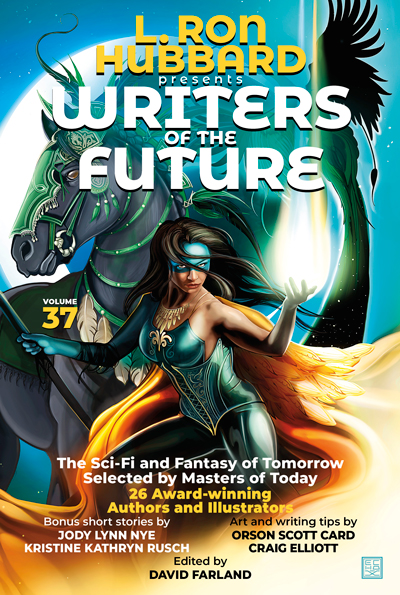
L. Ron Hubbard Presents Writers of the Future Volume 37
Discussion Guide
“The Tiger and the Waif”
by John M. Campbell
After a devastating earthquake, a toy kitten crawls out of the rubble, free at last. Deep in its programming, an urge demands to be fulfilled.…
- Which would you prefer for a pet: a “smart” toy cat like the one in the story, or a real cat? Why one over the other?
- Were the people who made Tiger cruel to program him only to say “mew”? Should they have put in a switch to allow Tiger to talk (like Siri or Alexa)?
- Why does Tiger save the little girl? Is he driven by his programming, or does he learn to love her?
- Can an artificial intelligence ever experience love? How is Tiger’s “love” different from the love expressed by a real cat or a human?
“Sixers”
by Barbara Lund
When war comes home, a mysterious sixth-senser must use her talents and the help of three orphans on a journey across a devastated city to find her son.…
- Most heroes have huge, flashy powers. How does the main character deal with having small magic? What could you do with small magics?
- The main character has cultivated a specific persona. Why do you think she did this? How could she have disguised herself better? How would that have changed the story?
- Was it fair for the main character to ask the boys to help her get through the ambush? Why or why not? Has an adult asked you to do something that wasn’t fair?
“The Enfield Report”
by Christopher Bowthorpe
A scientist must choose between ambition and compassion while forced to participate in a secret and sadistic government project.…
- Near the beginning of the story, General Leish refers to Dr. Frederick Tormer as “a psychopath—a very useful ” What do you think makes Tormer “very useful”? What insights into Leish’s character does your answer reveal?
- Enfield describes the Voyager mission on Nossos as “a peaceful colonization,” to which Zriel responds, “Every colonization in history was peaceful until one side decided differently.” Is he correct? Explain. Can you think of any colonization efforts throughout human history that did not result in open conflict between the indigenous peoples and the colonizers? If so, which ones?
- How would you describe Coral’s attempt to “save” the Nossian? Did she act foolishly in removing his muzzle after being warned not to do so? Would you have done the same in her place, knowing what she knew at the time? Why or why not?
- Were you surprised when Tormer saved Coral’s life? Were you surprised when he relented at her order to not kill the Nossian? Did Tormer indeed do “something good, even if it was for the wrong reason”? If his motivations were wrong, but his act was indeed good, can that act be redeeming? Explain.
“The Widow’s Might”
by Elizabeth Chatsworth
A Victorian tea shop owner hopes to serve justice to wicked gangsters—with the help of a mysterious new friend.…
- Is Morrigan a force for good or evil?
- Did Morrigan use technology or magic to achieve her goals?
- Did Ice-pick Charlie and his thugs deserve their fate?
- Will Brina become “a catalyst for positive change” in her community?
- In Brina’s situation, would you step up to become head of the Tea Ladies? Why did you make the choice you did?
- Would Mr. Tibbles approve of Brina’s new best friend?
“The Dangerous Dimension”
by L. Ron Hubbard
Meek Dr. Henry Mudge has a dramatic personality change after discovering a mathematical equation that transports him to any place in the universe he can think of.…
- Do you think a good story invites damning in one way or another? Why? What examples from this entire book do you think of?
- Ron Hubbard supplies philosophical ideas that support mental projection used in this story. Do you believe that falls into science fiction or fantasy? Why? Do you believe mental projection is possible? Why?
- If you could transport yourself to any place you chose, where would it be? And where wouldn’t you want to be transported to?
- Mudge is described as seeming to be a brave man if he was examined from within, but from without was a different matter. Do you know of people who appear that way? How can you see them for who they really are?
“How to Steal the Plot Armor”
by Luke Wildman
In a magical kingdom overrun by “chosen ones,” a wizard grows weary of always being the mentor and decides to do something about it.…
- Based on the narrator’s actions and impulses throughout the course of this story, do you see him as a morally upright person? Is it possible for someone to be ethical even if their actions don’t match their thoughts or words?
- Many of the main characters in this story are outsiders, both in traditional story structure and in their world. Wherever you live, do you see yourself as a main character? Who is your supporting cast? What would it mean for an outsider in your society to steal the plot armor, and how can you be an ally to them in this endeavor?
- This story draws tropes from fantasy, mythology, and heist stories. Which tropes do you recognize, and how are they subverted to create twists?
- What narrative purpose do the Rules Three serve? How did you react as each rule was broken, and how does this process correspond to the story’s rising action?
“The Redemption of Brother Adalum”
by K. D. Julicher
There can be no redemption for a man who has lost control of his warrior-bear spirit—only penance. Or so Adalum believes.…
- Did Adalum break his vows, or not? Was he justified in his actions?
- Is pacifism, when it puts the lives of others at risk, a moral choice? Why or why not?
- Do you think Adalum’s Confessor is a literal being, or a manifestation of his own subconscious? Why does the templar think Adalum is at risk meeting with the Confessor?
“The Argentum”
by Anj Dockrey
The starship that brought mankind to its first colony among the stars was powered by a godlike being, who now wants to know what it is to be human.…
- Imagine you were on a colony ship. How would you equip it and what would your role be?
- Merope fears that Argent does not have the capacity for love because he doesn’t feel pain. Do you think she’s right? Explain.
- Earth’s literature has led Argent to believe that when humans die, they become energy beings like himself. What is your theory of what happens after death?
- Merope refuses Argent’s offer to help her gain immortality. What would you do in her position?
“The Phoenixes’ War”
by Jody Lynn Nye
When a lover’s gift to her king turns out to be a perilous trap, the Phoenixes and their priestess face a test that will decide the fate of two realms.…
- How has the writer shown the ways in which Melana matured since the first story, “The Phoenix’s Peace”? How has having to care for the twin Phoenixes changed her?
- There is only meant to be one Phoenix in existence at a time, so the twins Coletwa and Solingwa must differ from their previous single self. How are those differences reflected in the story? Is it important to you for the legend to remain unchanged from tradition? Why?
- What do you think of the test that Eona’s uncle set for the king and court of Dembia? Was it fair? Underhanded? Manipulative? What do you think it was meant to evince?
- If you were writing this story, what would you have had Melana do differently?
“Soul Paper”
by Trent Walters
Her grandfather taught her how to create music from the soul, but does it come at too high a price…?
- What makes a soul? What breaks a soul? Are there nuances to this?
- How does mental illness shape the narrative?
- Why is the narrator the ideal main character? Or is she not?
- Why does the story encompass most of the narrator’s life instead of just the events leading to her experience of the soul?
“The Skin of My Mother”
by Erik Lynd
A woman who once escaped her destiny returns home to find it won’t be so easy the second time.…
- In the story, Elise blames her mother for the death of her child. Specifically, the way her mother raised Elise (believing in magic and reliance on folk remedies instead of science and doctors) as the cause of death. Do you think she was justified in blaming her mother for her decisions or was it Elise’s fault? Were both at fault?
- In the story, despite horrible tragedy combined with different life choices, family love wins out. Elise accepts the inevitable fate of taking on her mother’s work, whether she is fully conscious of it or not. Do you believe this is true in most families? Is family love truly unconditional?
- Are we destined to take on some aspect of how we were raised, the family business, strong mannerisms, likes or dislikes? Where does the individual become separate from the family?
“Death of a Time Traveler”
by Sara Fox
Time runs in a circle, beginning where it ends—but father has always been out of sync.…
- How do you think the mechanics of a time traveler work in this world, and would you want to be a time traveler given the constraints?
- What reasons might the narrator have for not wanting to leave a digital or social trail of their father’s status as a time traveler?
- Both grief and time are presented as nonlinear in this story. How would you handle grief knowing the deceased might reenter your life but in their own [the time traveler’s] past?
“The Battle of Donasi”
by Elaine Midcoh
A guilt-ridden war hero finds herself in an unexpected extraterrestrial battle, confronting the prospect of having to kill again.…
- Linae feels tremendous guilt regarding the death of the Hiturans. To what extent should a person be held responsible—or hold herself responsible—for the unintended consequences of one’s actions?
- During the battle it becomes clear that the Donasi have no chance of winning. Ensign Flare thinks it’s stupid to keep fighting, while Ensign Terry says it’s courageous. Which is it? Can you think of similar examples in human history where people kept fighting even though their situation was without hope?
- Were you surprised when Linae surrendered her ship? Would you have thought of that? How would you have resolved the situation?
- Can you think of examples when a more powerful entity/person yielded to a weaker one in a conflict? Was there a good result?
- What did you think of Ash’s and Linae’s friendship? In times of trouble have you ever been buoyed by a good friend—or have you been that good friend?
“The Museum of Modern Warfare”
by Kristine Kathryn Rusch
When an ambassador is asked to inspect the controversial Museum of Modern Warfare, she discovers life-changing secrets.…
- Weigh the ethics of the museum’s presentation of the past war. What positivity and negativity did you feel when you first discovered the method of display?
- What about the museum affected you emotionally and why?
- What good can come from facing traumatic incidents in your past?
“A Demon Hunter’s Guide to Passover Seder”
by Ryan Cole
Noam only hopes to have a normal Seder, but he’ll have to battle his brother’s new girlfriend and the demons that follow her.…
- Is Noam justified in blaming Abigail for the death of Zaydee?
- Do you think Elijah, the eternal prophet who is given a place at the Seder table, played a role in helping Noam vanquish his family’s demons?
- All of the demons that Noam encounters are referenced, in some capacity, in Jewish religious text or lore. In the context of this story, what do you think these demons represent? Are they real, or rather a manifestation of Noam’s unwillingness to accept Abigail into his family?
- Does your family have any traditions that you would like to see passed down to future generations? What are the benefits of sharing those traditions with individuals outside of your family?
“Hemingway”
by Emma Washburn
A young girl in a plastic boat finds herself at the doorstep of a mysterious old man living in a house built in the middle of the ocean.…
- What do you know about the old man from the authors and books he likes to read?
- Why do you think the old man wouldn’t let the two of them share their names? What’s the power or value behind a name? What do you think the little girl said to the old man, and why did he take her name at the end?
- Whether or not the old man and his house are real was left up to the reader’s interpretation of the world. Did you see it as real or imagined? What do you think someone’s interpretation of that reality says about them?
- Could the house have been prevented from sinking? Is it possible for someone to cling to their adolescence?
- Do children have more vivid imaginations than adults? Is creating a fantasy world with people and stories a good thing? Why do you think so? Is there a difference between imagination and fantasy? Can you keep a fantasy alive?
“Half-Breed”
by Brittany Rainsdon
When tensions between humans and dryads boil over, a teen must bridge the gap between the old world and new, before everything she loves turns to ash.…
- Sequoia judges her father for not using his gift to change her world, only to realize at the end he was saving his gift for her. Can you think of a time you have misjudged a person or situation? When you realized your mistake, how did you readdress the person/situation?
- While preparing for the summoning ceremony, Sequoia expresses the belief that she doesn’t fit in. Her father insists she can choose to belong. Who is right? Why?
- If you could have a trigani seed, which power would you hope to receive? How could that power be used to change the world?
- Why does Sequoia’s father believe she will be able to bridge the divide between humans and dryads? How can people with opposing beliefs and vastly different backgrounds come together?