
 ISBN: 978-1-59212-399-5
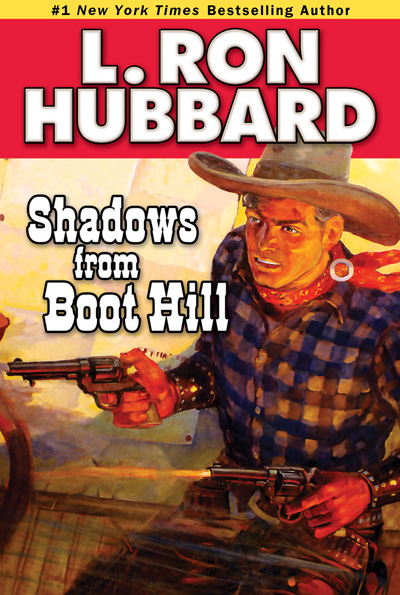
Shadows from Boot Hill
(also includes Gunner from Gehenna and Gunman!)
Discussion Guide
Shadows from Boot Hill Story Summary & Overview
In Shadows from Boot Hill, fugitive gunman Brazos seeks refuge with businessman Whisper Monahan, who hires him to kill gold miner Scotty Brant and his son Swifty. Brazos becomes terrified by stories surrounding Bilbo, a formerly enslaved man believed to possess supernatural powers. After Bilbo’s funeral, Brazos discovers a mysterious second shadow following him and becomes convinced it belongs to Bilbo. During his attack on the Brants, another shadow appears, deepening his fear and confusion. Brazos eventually discovers he has misinterpreted what the shadows foretold. Scotty and Swifty remain alive and kill him and as Brazos dies, even his own shadow disappears.
Historical Context: Gold Mining and Slavery Context
The story draws upon several elements of the nineteenth-century American West: hired gunmen, mining camps, sheep and cattle country, isolated settlements, frontier law enforcement and disputes over land and water. One especially important historical issue is mining pollution. Scotty Brant uses cyanide to extract gold from oxide ore. According to the story, the process has contaminated the stream flowing through the valley and made the water deadly to sheep. The story also reflects the aftermath of American slavery. Bilbo had been enslaved by Scotty Brant in Louisiana before the Civil War and has remained with him afterward. The townspeople interpret Bilbo through racial stereotypes and rumors about voodoo rather than understanding him as an individual.
Chapter One: Shadows from Boot Hill
- Brazos’s considers the murder almost a public service and complains more about failing to collect his five hundred-dollar payment than about taking a human life. Discuss how the author establishes Brazos’s character through his attitude toward murder rather than simply describing him as a criminal.
- The approaching posse leaves Brazos with few alternatives. Discuss how desperation can force people into alliances with individuals they distrust and how that imbalance can give one person power over another.
- Brazos’s immediate problem is escaping the posse and Whisper presents murder as the price of assistance. Discuss whether Brazos makes a genuine choice or simply follows the pattern of violence that has already shaped his life.
Chapter Two: The Necklace of Human Teeth
- Scotty Brant mining operation contaminates the stream and makes the valley dangerous to livestock. Discuss how conflicts over natural resources can create hostility between different industries and communities.
- Whisper does not personally confront Scotty. Instead, he repeatedly hires others to do the killing for him. Discuss whether paying someone to commit violence creates less, equal or greater moral responsibility than committing it personally.
- Bill Slocum describes Bilbo as a witch doctor responsible for mysteriously disabling Scotty’s previous attackers. Discuss how rumor can create a reputation powerful enough to influence people’s behavior even when they cannot verify the underlying facts.
Chapter Three: Black on White
- Brazos is accustomed to gunfights and killing, but uncertainty about Bilbo’s supposed supernatural powers undermines the confidence upon which he normally depends. Discuss whether fear is intensified when people cannot define the danger they face.
- The silver cross was given to him as a lucky object and he convinces himself that something Christian must protect him against what he considers pagan magic. Discuss how objects can acquire psychological power because of the meaning people assign to them.
- Bilbo’s final words, “I get you, white man” remain in Brazos’s mind long after Bilbo dies. Discuss whether their power comes from a supernatural curse, Brazos’s guilty conscience, his superstition or some combination of all three.
Chapter Four: Two Shadows!
- The conversation at the funeral increase Brazos’s fear. The townspeople speculate about witch doctors, ghosts, curses and the mysterious deaths of earlier gunmen. Brazos responds by becoming angry and insisting that nothing can frighten him. Discuss why anger can sometimes function as a defense against fear.
- Brazos tests the discovery of the second shadow rationally by moving his arms and hat, yet the shadow refuses to imitate him while continuing to follow him. Discuss how the author combines Brazos’s attempts at logical investigation with an apparently impossible event.
- Instead of abandoning Whisper’s plan, he convinces himself that killing Scotty and Swifty will somehow cause Bilbo’s shadow to disappear. Discuss how fear can lead people to construct explanations that justify actions they already want or feel compelled to take.
- Throughout the story, shadows become associated with death. When Brazos dies, his own shadow is gone as well. Discuss whether the ending confirms the supernatural explanation, preserves ambiguity or simply gives poetic form to Brazos’s death.
The Gunner from Gehenna
Discussion Guide
The Gunner from Gehenna Summary & Overview
The story follows Bill Maynard, who is forced by the outlaw known as the Gunner to participate in robbing three miners of their gold. Refusing to help murder them, Bill escapes, warns the miners and helps protect them. The Gunner nevertheless steals the gold and leaves behind a deadly trap involving dynamite and a gun, which Bill discovers in time. Pursuing the outlaw into the desert, Bill finds a way to capture him without killing him. Using his deputy sheriff’s badge to puncture his canteens, Bill creates a water trail that draws the desperate Gunner toward him, defeating his enemy through courage and cleverness.
Historical Context: American West History & Gold Mining
The story reflects a familiar period in Western history when formerly violent frontier communities were becoming more settled. Bill remembers that after the Gunner’s gang disappeared, Bull Butte became “a quiet, peaceful town in which a man could prosper and grow old.” The Concord Mine reflects another important feature of the West: individual prospectors spending years searching for mineral wealth. The story also depends heavily upon the realities of desert travel. Water, horses, route knowledge, heat and physical endurance become more important than gunfighting ability. The Gunner can shoot extraordinarily well, but his greed leads him to overload his animals with gold and his loss of water ultimately defeats him.
Discussion Questions
- Before he fires a shot or makes a direct threat, his scar, pearl-handled revolvers, physical appearance and reputation silence the room. Discuss how reputation itself can become a form of power and why people may respond to what someone has done in the past before knowing what that person intends to do now.
- Bill is unarmed, while the Gunner has a revolver pressed against him and has carefully chosen a moment when assistance is unlikely. Discuss why refusing to fight immediately does not necessarily indicate cowardice and how survival may require waiting for a better opportunity.
- The Gunner believes the disappearance of violent men has allowed weaker people to become prosperous. Bill sees the same transformation as evidence that Bull Butte has become a decent place to live. Discuss how the two men define strength differently and what each definition says about the kind of society he values.
- Bill knows Cactus Jake, Larry and Buzz personally and believes they have earned the right to enjoy the gold they spent years finding. Discuss what Bill’s refusal reveals about the difference between having a price and having principles.
- The Gunner is an exceptional marksman and watches Bill carefully. Bill waits until a dropped revolver distracts him and the lead rope becomes slack before acting. Discuss how patience, timing and realistic assessment of an opponent can be as important as physical courage.
- The apparent escape causes Bill and the three miners to concentrate on finding the Gunner while leaving the mine temporarily unprotected. Discuss how the Gunner manipulates his opponents by allowing them to believe they have successfully disrupted his plan.
- When they discover that the gold is missing, the three men silently look at Bill as though he may have helped the Gunner. Bill knows he is innocent, but circumstances make him appear guilty. Discuss how difficult it can be to maintain confidence in one’s own character when trusted friends believe the worst.
- The Gunner has arranged a hidden wire connecting a weapon to dynamite so that anyone disturbing the strongbox could be killed, allowing the deaths to appear accidental. Discuss how this calculated willingness to kill people unnecessarily distinguishes the Gunner’s intelligence from Bill’s equally clever but morally different problem-solving.
- Bill finds Maribelle and later the Gunner’s roan suffering from thirst and heat. Instead of treating the animals merely as tools belonging to his enemy, he gives them water, cactus, food and rest. Discuss what the treatment of vulnerable animals can reveal about character, especially during a life-and-death pursuit.
- Bill secretly punctures the canteens with the badge pin while pretending merely to drink. Days later, the Gunner’s water is gone and the desert accomplishes what Bill could not safely accomplish through a direct gunfight. Discuss why this ending makes intelligence, foresight and understanding one’s environment more important than superior firepower.
Gunman!
Discussion Guide
Gunman! Story Summary & Overview
In Deadlight, veteran marshal Brazos Kincaid faces replacement because banker John Kilgore considers his frontier methods outdated. When $100,000 in railroad gold arrives, Brazos discovers that the McCall gang plans to rob the bank and that his deputy, former outlaw Shorty Denester, is involved. Brazos secretly recruits three Mexican outlaws as deputies and prepares an ambush. Using a dummy of himself as bait, he traps and defeats the gang, eventually killing Shorty and exposing his earlier murder. Impressed, Kilgore asks Brazos to remain marshal. Brazos also receives enough reward money to keep his son in medical school, proving his usefulness remains undiminished.
Historical Context: American Frontier and Pinkerton Detectives
The story takes place during the transformation of the American frontier, when settlements that had once depended upon individual gunfighters and locally chosen peace officers were becoming permanent towns connected by banks, railroads, courts, professional businesses and larger institutions. The coming railroad represents that transformation. Railroad representatives are buying enormous amounts of land for tracks, watersheds, timber and other needs. Residents imagine that once the rails arrive, Deadlight will become almost unrecognizable. The story also introduces Pinkerton detectives, reflecting the increasing use of professional private security and investigative organizations.
Chapter One
- Pete Sims witnessed the shooting and confirms that the Wilton kid provoked the confrontation. Brazos therefore judges the event itself rather than Shorty’s reputation alone. Discuss whether a person’s criminal history should influence how authorities evaluate a new accusation.
- Shorty claims that he has left the McCall gang and originally came to Deadlight seeking a deputy’s job. Brazos gives him an opportunity despite knowing his past. Discuss whether offering responsibility to someone with a troubled history can encourage genuine reform—or create unnecessary danger.
- The arrival of $100,000 in gold is important beyond simply creating the possibility of robbery. The money symbolizes the new West: railroads, large corporations, land purchases, banks and outside investment. Yet this symbol of progress immediately attracts an ancient motive—greed. Discuss how the gold supports Brazos’s argument about changing circumstances but unchanging people.
- Brazos sudden anger surprises even Brazos himself and afterward his hands shake. Discuss whether his reaction is really about the drunken man or whether losing his job has forced Brazos to confront fears about aging, usefulness and the future.
Chapter Two
- Residents see economic opportunity and imagine a transformed town, while old-timers repeatedly remark that the country is changing. Discuss how major technologies can simultaneously create prosperity and threaten familiar ways of life.
- The former Pinkerton believes that courts, brains and professional law enforcement will replace gun smoke. Discuss whether Jocelyn is rejecting violence itself or simply assuming that modern institutions make someone like Brazos unnecessary.
- Brazos plays cards with Ramon Cinquez and his companions rather than arresting them. He recognizes them as dangerous men and immediately suspects that the $100,000 may have attracted them. Instead of making an unnecessary confrontation, he sits down, disarms everyone and begins gathering information. Discuss what this reveals about Brazos’s intelligence beyond his skill with a revolver.
- From Kilgore’s perspective, a marshal with an outlaw past has been seen socializing with three criminals shortly before $100,000 is to be distributed. Discuss how reasonable evidence can produce a completely incorrect conclusion when important information is missing.
Chapter Three
- Brazos apparent absence encourages Kilgore and the Pinkertons to relax while Brazos investigates elsewhere. Discuss how appearing defeated or irrelevant can sometimes give
someone a strategic advantage. - Earlier, Brazos gave Shorty the benefit of the doubt and even a badge. Now Shorty deliberately fires at what he believes is Brazos’s unprotected back so that the McCall gang can rob the bank. Discuss whether Brazos was wrong to trust him or whether giving someone an opportunity remains worthwhile even when that person ultimately betrays it.
- Shorty discovers that the man he believed he had murdered is alive and waiting for him. When Shorty reaches for his gun, Brazos kills him and identifies him as the murderer of the Wilton kid. Discuss how this revelation forces readers to reinterpret the opening scene and Brazos’s earlier decision to trust Shorty.
- Railroads, farms, banks, professional detectives and expanding settlements have transformed the surroundings. Yet the night’s events still involve greed, betrayal, courage, loyalty, cowardice, intelligence and violence. Discuss whether today’s world has proved Brazos’s argument.