
 ISBN: 978-1-59212-297-4
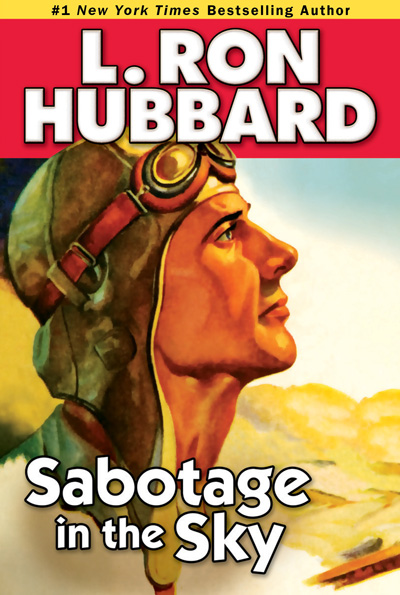
Sabotage in the Sky
Discussion Guide
Sabotage in the Sky Story Summary & Overview
Ace test pilot Bill Trevillian returns to Beryl-Cannard Airlines to test its revolutionary BCA 41 Pursuit fighter while Kip Lee tests the rival L97 designed by her brother Terry. Unknown to them, Nazi agent Erich von Straub has infiltrated BCA and is sabotaging both aircraft so Britain and France will reject them. Bill and Kip mistakenly blame each other, turning professional rivalry and attraction into hostility. When von Straub steals the BCA 41 and kidnaps Bill, Kip pursues him in the L97. She battles von Straub over the Atlantic, protects Bill and helps expose the sabotage—proving both her courage and her ability as a pilot. Like all good stories Bill and Kit end up with thirteen thousand dollars, enough to buy a cabin plane and get married.
Historical Context: Social, Military & Aviation
Sabotage in the Sky appeared in the August 1940 issue of Five-Novels Monthly, while World War II was already underway in Europe but more than a year before the United States formally entered the war. That timing is important because the story imagines American aviation technology becoming crucial to Britain and France while the United States itself remains outside the fighting. The story centers on competition to produce faster and more maneuverable military aircraft. Beryl-Cannard’s BCA 41 and Terry Lee’s L97 are fictional designs, as is the story’s Messerschmitt 118D. Nevertheless, the technological race they represent was very real. By 1940, speed, armament, maneuverability, engine performance and production capacity had become critical factors in determining whether a nation could achieve air superiority. Espionage and industrial sabotage provide the second historical dimension. Von Straub enters the United States with forged documents, obtains employment as a mechanic and secretly damages aircraft so that genuine mechanical failures appear responsible.
Kip Lee adds an important social dimension. Bill initially assumes that a woman cannot be an exceptional pilot and laughs after her wheels fail to lower. Kip later laughs when Bill experiences his own disastrous landing and repeatedly demonstrates that her flying ability deserves to be judged on performance rather than gender. The story reflects period stereotypes about women while simultaneously making Kip one of its most capable and courageous characters.
Discussion Questions
- Von Straub’s assignment is not simply to destroy airplanes; he is supposed to make British and French officials believe that the American designs are unreliable. Discuss the difference
- between destroying something and destroying people’s confidence in it. Why can reputation become strategically important during wartime?
- Bill Trevillian accepts the dangerous job of testing the BCA 41 even after learning that two previous test pilots have died flying it. Discuss the qualities that separate courage, professional confidence and recklessness. Where would you place Bill’s decision?
- When Kip makes a wheels-up landing, Bill immediately assumes that she has made a foolish mistake and jokes that women cannot fly. He later experiences a dangerous landing himself because his aircraft has been sabotaged. Discuss how quickly people sometimes form judgments without having all the facts. Why can expertise make someone overconfident in those judgments?
- Kip has admired Bill since childhood and has worked for years to become the kind of pilot whose ability he would respect. Yet Bill does not even recognize her when they meet as adults. Discuss the advantages and dangers of building personal ambitions around winning another person’s approval.
- Both the BCA 41 and the L97 are competing for an enormously valuable foreign contract. When Bill discovers evidence of sabotage, he initially suspects Kip and Lee Aircraft. Discuss how competition can encourage people to interpret evidence according to what they already believe about a rival. What should Bill have done before accusing Kip?
- Bill eventually discovers that an oil-pressure gauge has been deliberately altered so that the pilot receives misleading information. Discuss the larger importance of accurate instruments and reliable information in aviation. What does this episode suggest about situations in which people must make life-or-death decisions based on information supplied by technology?
- Bill and Kip repeatedly misunderstand one another because each sees genuine sabotage
and assumes the other side is responsible. Discuss how suspicion can become self-reinforcing. Once people believe someone is an enemy, why can even innocent behavior begin to look like evidence of guilt? - Terry Lee is trying to save a struggling aircraft company, while Beryl-Cannard is also financially dependent upon winning the contract. Both companies therefore have powerful economic motives to defeat the other. Discuss whether strong financial motives are sufficient reason to suspect wrongdoing. What additional evidence should be required?
- Bill wants to catch the saboteur in the act rather than immediately bringing in authorities, believing that publicity could frighten the culprit away. Others argue that the FBI should become involved as soon as sabotage is suspected. Discuss the advantages and dangers of Bill’s approach. When should an individual investigation give way to professional law enforcement?
- The story initially presents Kip’s skill partly as a challenge to Bill’s assumptions about women, but during the final pursuit she faces genuine combat rather than a controlled demonstration. She follows von Straub through difficult maneuvers even though her previous experience has been training rather than actual aerial combat. Discuss how preparation, courage and adaptability combine when someone encounters a situation more dangerous than anything for which they have trained.
- During the final confrontation, Kip must decide whether to attack von Straub’s aircraft while Bill is aboard it. She cannot simply shoot down the enemy plane without risking the person she is trying to save. Discuss how the presence of an innocent person changes the ethical and tactical choices available during a conflict.
- By the end of the story, Kip has demonstrated her abilities under conditions far more demanding than the original aircraft competition. Discuss how the story’s meaning changes when the professional rivalry between Bill and Kip becomes a struggle against a common enemy. What does the ending suggest about judging people by stereotypes, first impressions or competition rather than by what they actually do?