

The Fur Trade That Changed the American West
How European fashion, frontier commerce, and historical research influenced L. Ron Hubbard’s Buckskin Brigades.
A Fashionable Beginning

Beaver fur hat, Samuel O. Aborn, circa 1840. The Metropolitan Museum of Art.
What could a fashionable gentleman’s hat in London or Paris possibly have to do with the opening of the American West?
Quite a lot, as it turns out.
For more than two centuries, European demand for beaver-felt hats helped drive one of North America’s most consequential industries: the fur trade.
The secret was in the beaver’s underfur. Its fine, densely packed fibers could be worked into durable, water-resistant felt, ideal for the hats fashionable European gentlemen prized.
As European beaver populations declined, merchants increasingly turned to North America for their supply.
A beaver fur hat purchased in London might begin its journey as a pelt trapped beside a remote Canadian river, exchanged at a wilderness trading post, transported hundreds of miles by canoe, and eventually shipped across the Atlantic.
Behind this seemingly ordinary article of clothing lay an extensive network of hunters, traders, merchants, and explorers.
And that network would help shape the American frontier.
The Business of the Wilderness
By the early nineteenth century, the fur trade had become an international commercial enterprise.
British, French Canadian, and American interests competed for access to valuable trapping territories. Trading companies established remote posts, organized expeditions, and sent men into regions largely unfamiliar to European and American mapmakers.
Among the most influential enterprises were the Hudson’s Bay Company and the North West Company, whose trading networks stretched across enormous distances.
One of the most ambitious American entrepreneurs was John Jacob Astor, who established the Pacific Fur Company in 1810 with the aim of developing a trading network reaching the Pacific Coast.
His enterprise would later become the subject of Washington Irving’s Astoria, published in 1836.
The fur trade also gave rise to one of the most recognizable figures of American frontier history: the mountain man.
Trappers such as Jedediah Smith and Jim Bridger became known for their journeys through the Rocky Mountains, navigating remote passes, surviving harsh winters, and searching for the valuable beaver.
Smith, for example, traveled through vast stretches of the American West at a time when reliable maps were scarce and journeys into unfamiliar territory could prove fatal.
Yet the popular image of the solitary mountain man tells only part of the story.
The industry depended upon Indigenous hunters and traders, French Canadian voyageurs, company employees, merchants, and Native American communities whose knowledge of the land was essential to travel and commerce.
It was an enterprise built upon cooperation, competition, opportunity, and frequently, conflict.
For a short history on the Beaver Felt Trade as it relates to the Canada region, watch this:
The Price of Expansion
The fur trade opened commercial routes across the continent, but its consequences extended far beyond economics.
As trading companies pushed westward, they entered territories occupied by Native American nations with established political relationships, trading systems, and interests of their own.
Trade brought new opportunities. Firearms, metal tools, textiles, and other manufactured goods became increasingly important commodities.
But competition for trading partners, resources, and territory also intensified existing rivalries and created new tensions.
The Blackfeet Confederacy, whose territory extended across portions of present-day Montana and Alberta, occupied a strategically important region near the northern Rocky Mountains.
The Blackfeet participated in regional trade while defending their territory and commercial interests from encroachment.
Relations with incoming traders were therefore complicated. Exchanges and alliances could coexist with suspicion, confrontation, and violence.
The Lewis and Clark Expedition encountered these tensions in 1806.
During the expedition’s return journey, a confrontation between members of Meriwether Lewis’s party and a group of young Blackfeet ended in the deaths of two Blackfeet.
The incident became part of the historical record of the expanding American presence in the region.
In subsequent decades, competition over trade and territory continued to shape the northern frontier.
The fur trade was not simply a story of adventurous trappers entering an empty wilderness. It was an encounter between established societies and expanding commercial ambitions, with consequences that endured long after the fashionable beaver hat had lost its popularity.
An Unexpected Discovery
In the 1930s, L. Ron Hubbard came upon this history quite by chance.
As he recounted in his essay “Search for Research,” he was sitting one evening, bored, staring at a shelf of books.
The volumes looked so monotonous that he reached for one simply to break the visual uniformity.
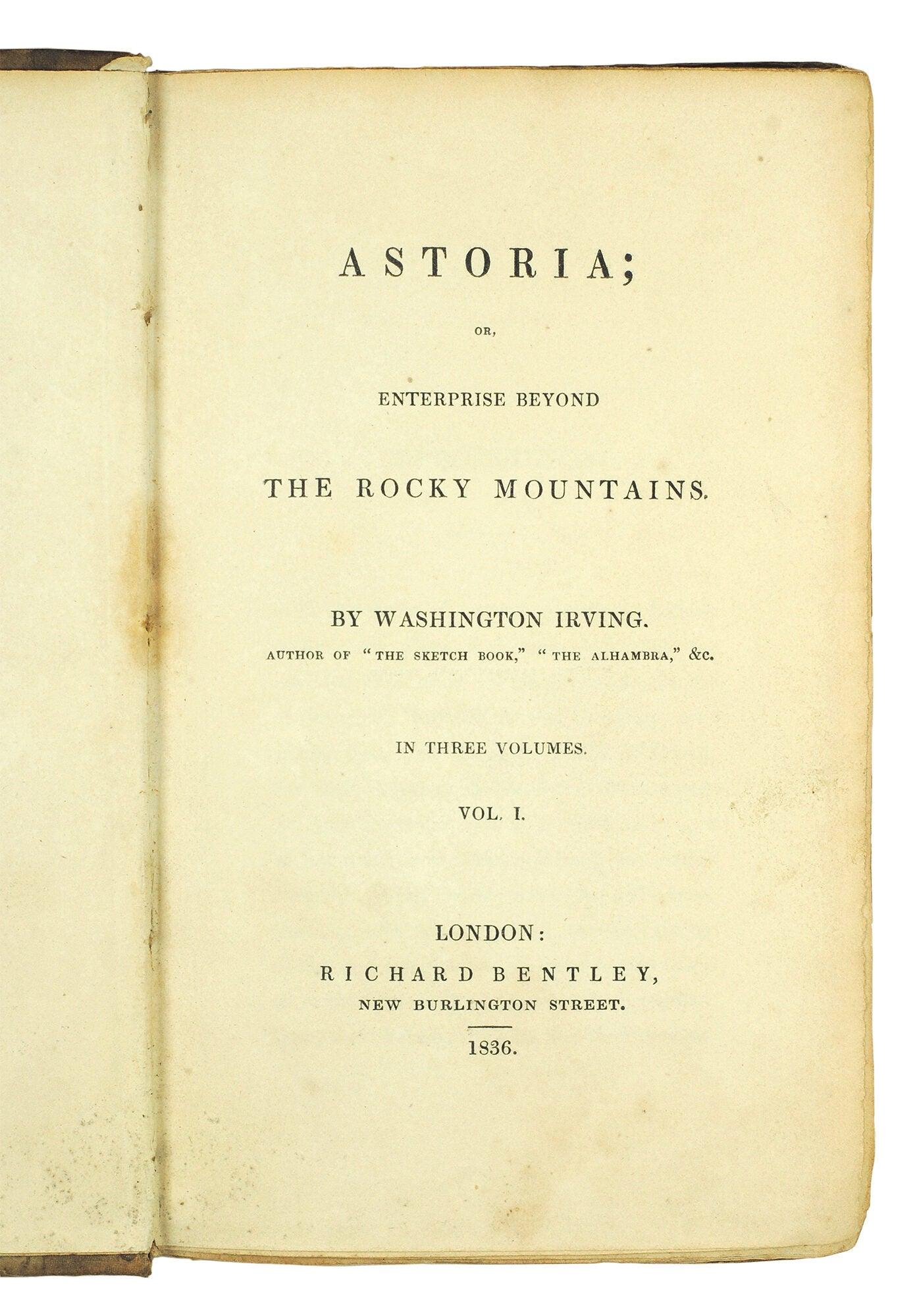
Title page of Washington Irving’s Astoria (1836). Digitized historical edition.
It happened to be Washington Irving’s Astoria, an account of John Jacob Astor’s ambitious fur-trading enterprise.
Hubbard was surprised to discover that Irving had written such a book and began reading it out of curiosity.
That chance encounter prompted him to investigate the fur-trading history of the Pacific Northwest.
He consulted reference works, located historical accounts, and began following the journals of traders and explorers.
But something caught his attention.
Again and again, he encountered descriptions portraying the Blackfeet as exceptionally warlike and bloodthirsty.
Having known Blackfeet people during his youth in Montana, he questioned whether these accounts presented the whole story.
He turned to additional contemporary records, including the journals of fur trader Alexander Henry, searching for a fuller understanding of the events.
His research also led him to the journals of Lewis and Clark and their account of the deadly confrontation with the Blackfeet in 1806.
Gradually, the historical accounts began to suggest a story.
The Hudson’s Bay Company, the North West Company, John Jacob Astor, the Blackfeet, and the competing interests of the fur trade provided the material for a novel.
What began as an idle moment before a bookshelf had developed into a substantial historical investigation.
And that investigation became Buckskin Brigades.
A Different View of the Frontier

Published in 1937, Buckskin Brigades follows Michael Kirk, a white man raised among the Blackfeet and known to them as Yellow Hair.
Set against the Lewis and Clark Expedition and the expanding fur trade, the novel brings together historical events, commercial rivalries, frontier violence, and the competing loyalties of its central character.
What distinguished the book from many Western novels of its day was its perspective.
Rather than presenting fur traders and explorers as unquestioned heroes, Hubbard examined the ambitions and conduct of those entering Native American territory.
In his preface, he explained that he had sought to portray the fur traders as they appeared in historical records rather than in popular legend.
The result was a historical adventure that challenged some of the familiar conventions of Western fiction.
From Beaver Fur Hats to Buckskin Brigades
By the middle of the nineteenth century, changing fashions and declining beaver populations had contributed to the waning importance of the traditional beaver trade.
But the industry left an enduring legacy.
Trading routes became pathways for further exploration and settlement. The exploits of mountain men entered American folklore. Their adventures inspired generations of Western writers.
And the historical records they left behind continued to offer material for those willing to look beyond the legends.
For L. Ron Hubbard, that meant examining the fur trade through the accounts of the people who experienced it, questioning familiar interpretations, and ultimately bringing a different perspective to the American frontier.
There is a certain irony in the story.
An industry driven in part by the European appetite for fashionable hats made from beaver fur pelt helped shape the history of the American West.
And more than a century later, a book about that industry, pulled almost at random from a shelf, helped inspire Buckskin Brigades.
Sometimes, the most interesting stories begin with the smallest discoveries.
References and Further Reading
-
L. Ron Hubbard, “Search for Research.”
Hubbard’s firsthand account of his research methods and the discovery of Washington Irving’s Astoria, which led to the writing of Buckskin Brigades. Reproduced in Writers of the Future instructional materials. Read “Search for Research”
-
Washington Irving, Astoria, or Anecdotes of an Enterprise Beyond the Rocky Mountains (1836).
A historical account of John Jacob Astor’s Pacific Fur Company and the early fur trade in the American Northwest. You can read the book on Amazon or view the historical record at The Oregon Encyclopedia: Astoria
-
National Park Service, “Mountain Men and the Fur Trade.”
Historical background on the Rocky Mountain fur trade, the demand for beaver pelts, and the expansion of trapping expeditions. National Park Service: Mountain Men and the Fur Trade
-
The Oregon Encyclopedia, “John Jacob Astor (1763–1848).”
The development of Astor’s fur-trading enterprises and their role in the commercial expansion of the American West. The Oregon Encyclopedia: John Jacob Astor
-
National Park Service, “Two Medicine Fight Site.”
Historical information on the 1806 confrontation between Meriwether Lewis’s party and young Blackfeet men, including perspectives from Blackfeet oral history. National Park Service: Two Medicine Fight Site
-
L. Ron Hubbard, Buckskin Brigades (1937).
The novel and its author’s preface provide the primary literary reference for the article. L. Ron Hubbard Bestselling Novels Buckskin Brigades.

Leave a Reply
Want to join the discussion?Feel free to contribute!