
 ISBN: 978-1-61986-659-1
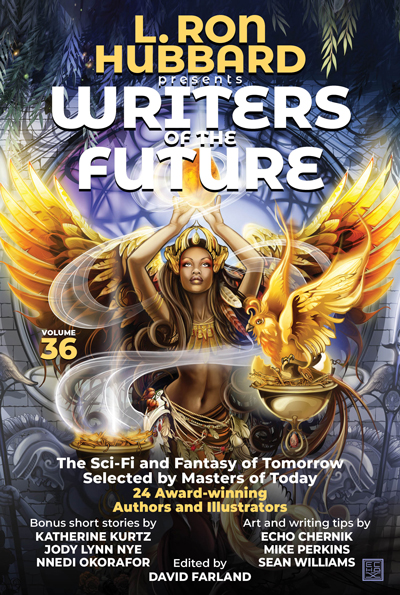
L. Ron Hubbard Presents Writers of the Future Volume 36
Discussion Guide
“The Trade”
by C. Winspear
An alien visits the International Space Station to provide a potential solution for climate change, at a price!
- Given the story’s implied threat of war and climate change, what are the pros and cons of accepting the trader’s deal? If you had to make the decision, what would you decide and why?
- Do you think the trader behaves ethically? Putting yourself in the trader’s shoes, what do you think is the most ethical way to treat a technologically inferior civilization?
- If the trader offered you one item from his list for free, what would you choose? How would you distribute this technology, and how would it impact the world?
“Foundations”
by Michael Gardner
A house is supposed to protect its family, not turn on one of its own.
- When Lacy is attacked by Uncle Carlton and the house, Poppy’s father blames Poppy. Poppy gets angry at Lacy. Grandma Dee wasn’t watching. Who do you think is most to blame? Can you understand why they each acted as they did?
- If Johnnie represents freedom from the responsibilities of a house and family, why does Poppy lose patience with him? What about Johnnie’s freedom does she come to dislike?
- Poppy’s rescue of Lacy causes more problems for her house and family. Do you think she was justified in acting as she did? Why, or why not?
- Poppy rebels against the responsibilities of her house and family.
- Yet she eventually agrees to do what her father wants her to do—run the factory. Did Poppy ever have a choice? If so, what decisions did she make along the way? What has she come to understand about herself and her family?
“A Word That Means Everything”
by Andy Dibble
How does one interpret the word of God so that an alien can understand?
- How would you express your religious or philosophical ideas to an alien race with a completely different understanding of the world and themselves?
- Must translators always remain faithful to the original text they are translating or are there compelling reasons for translators to depart from the original meaning? Consider the examples of innovative translation discussed in the story: flesh translated as spirit and logos translated alternatively as action, sun-principle, and gesture.
- Recall that the Thulhus only believe in the existence of their own minds. To what extent are we justified in believing that other minds exist, given that we only have our own case to extrapolate from?
- How successful do you think Pius was at communicating with the Thulhus?
“Borrowed Glory”
by L. Ron Hubbard
For a single day of glory and the settlement of a dispute among immortals, is a life a satisfactory price?
- The author states that Meredith “had never been known, to be forgotten.” Was hers a useless life? Is anyone’s? What makes a life useful or memorable?
- If you could have everything that you wanted but only for forty-eight hours, what would you wish for? After it was all taken away, do you think the memories of happiness would suffice? Are memories enough?
- Did the ending of the story surprise you? Why or why not? What were the clues that hinted at the ending?
- Who “won” the bet? More importantly, did Georgie cheat? If so, how?
“Catching My Death”
by J. L. George
Whether you catch a good death or a bad one determines the course of your life, unless you find a way to break free of the cycle.
- This story explores how the assumptions people make can affect the opportunities in someone else’s life. Sociologists call this a “self-fulfilling prophecy.” Can you think of some real-world examples?
- How do you feel about Ash and the choices she makes?
- Ash says that nothing could have saved Jacob’s life, but his mother still goes ahead with her safety campaign. Why do you think his mother does this?
- Ash chooses to keep her death, while Heather and her husband choose to have theirs removed and live their lives without knowing when they’ll die. Which would you choose, and why?
“A Prize in Every Box”
by F. J. Bergmann
The cereal-box toy looked like a TV remote, but the children discovered that it could fix anything, heal anyone—or change everything.
- Do you always trust that commercial goods—prizes in cereal boxes, for instance—will be safe to use?
- Under what circumstances should children disobey their parents?
- What do you think happened to Jason? To Alfie?
- Where do you think the last prize—the remote—came from?
“Yellow and Pink”
by Leah Ning
Nathan Reed steals the opportunity to repeat his life and prevent his wife’s untimely death.
- Do you ever ponder the possibilities and alternate “time lines” that could occur based on a single decision? Nathan believes that if only they’d gotten in the car a few minutes earlier or later, Holly wouldn’t have died. In order to explore all the possibilities, Nathan has to live his entire life over again each time. Would you ever do this? Why?
- What do the yellow and pink flowers that appear throughout the story represent?
- Holly was upset that Nathan killed someone to get his chance at saving her. What should he have done instead? At the end of the story, did Nathan do the right thing? Why?
- What might Nathan’s choices and their ultimate outcome show us about death and its role in everyone’s lives?
“The Phoenix’s Peace”
by Jody Lynn Nye
The Phoenix has always been the guardian of Dembia. Now there’s trouble in the land, and mysteriously, the Phoenix has left two golden eggs.
- What was your reaction when Melana was chosen to be a postulant, despite the fact that she doesn’t dream? What do you think of Aduna’s promise that “When the time comes, the Phoenix will fill your mind with dreams?” Ingalo states that the Jumheuri prophets dream often, and base their predictions on these dream visions. What might be the advantages and disadvantages of dreaming prophecies?
- Describe the priestesses’ mundane, daily duties as they await the arrival of the Phoenix. What, if anything, does this say about the role of religious leaders in the day-to-day lives of the faithful?
- The history professor Stihila told the postulants, “Always show mercy. . . . Drive them out, don’t wipe them out. Leave the enemy a means to escape, and they will respect you. The goal is peace. Knowing you will hold back the death blow is the most powerful weapon you wield. Retreat is honorable. Control your anger. Give them room to depart, no matter how much you want to break them.” In the conduct of warfare, do you believe this to be good advice? Why or why not? Did the Dembian forces heed Stihila’s advice in their battle against the Jumheuri? Did the Phoenixes?
- What do the relationships between the priestesses and their king and the Jumheuri and their sultan say about the relationship between religion and politics in society? How do these relationships translate from the world of the story into our world of the twenty-first century?
“Educational Tapes”
by Katie Livingston
Know there is nothing here to harm you. Only your choices. Only yourself. The educational tapes will prepare you for your choice, “I accept” or “I decline.” There are no other options.
- Near the beginning of the story, the tape that student 147B is listening to states that “the right choice made for the wrong reason is still the wrong choice.” Do you agree? Why or why not? Provide some examples (from literature or real life) to support your position.
- The state that presents the educational tapes seems to follow the maxim that the state and the members of its society should always strive to provide the greatest good for the greatest number, even at the cost of personal freedom and free will. This is known as “utilitarianism.” Discuss the pros and cons of a utilitarian society.
- Describe the symbolic significance of the path to be followed to get to the “non-existent” ocean: sneaking out at night, keeping off the roads and out of the cities, following the stream through the dead grass, the rocks, the trees, and the deeper forest, to the cliffs overlooking the sandy “beach” that is protected by an electric fence?
- What choice do you think 147B finally made? Was it the “right” choice? Why or why not? What choice would you have made? Explain.
“Trading Ghosts”
by David A. Elsensohn
A guilt-ridden cargo captain on a remote mining colony decides to help a fallen angel who desires to die.
- Ambrose decides to help an angel who no longer wishes to live. Do you feel the notion of assisted suicide is justifiable? Does this concept carry a different weight because the angel is not human? Is Zehanrael experiencing a different level of suffering?
- Despite reaching a future with space travel and living on other worlds, the concepts of capitalism, owned resources, and paid human labor continue to exist. Are these things required to advance civilization, or should humans have explored other options?
- While exploring the universe, humanity has discovered divine beings actually exist. Does this fact support the concept of faith? Would religions gain more influence because their claims are justified, or less influence because some claims are not supported by evidence?
- Is Ambrose justified in accepting responsibility and suffering guilt for Ulandre’s death?
“Stolen Sky”
by Storm Humbert
An artist leaves her homeworld to perform for humans across the galaxy, but finds that everything the humans have given her people may pale in comparison to what they’ve taken.
- What is the central theme of the story, and what are some of the points in the story that most clearly communicate and interact with this theme? Does the story make a point regarding its central theme? If so, what?
- What would this story be like if told from Ruya’s perspective? Use examples from the story to support your position. There are no right answers.
- By the end of the story, how do you think the main character’s understanding of authenticity differs from Ruya’s? How about their understanding of beauty?
- What is the value/function of the interactions with Ackchat and Sadiq for the main character? For the reader?
“The Winds of Harmattan”
by Nnedi Okorafor
A young woman seeks her destiny in the African winds of Harmattan.
- Flight has been used symbolically in many stories. What is the symbolic meaning of flight in this tale? Provide examples from the story to support your answer.
- What is the significance of Asuquo’s encounter with the old woman in the market at the beginning of the story?
- Did Asuquo ever actually meet her chi? If so, describe the encounter. Did Asuquo in fact die?
- Describe the differences between how men and women are treated in this story (Asuquo being made to eat poison to determine whether she is a witch, etc.) and consider these differences as they apply to the following quote, near the end of the story: “As the years passed, when storytellers told of Asuquo’s tale, they changed her name to the male name of Ekong. They felt their audience responded better to male characters.” Why would this be the case? How would these differences change the story fundamentally?
“As Able the Air”
by Zack Be
On the outskirts of a war zone scarred by endless conflict, a lonely landmine decommission expert struggles to connect with his nonhuman partner.
- Was Dart “sentient”? Why or why not?
- How would you describe Airto and the major’s perspectives on the war? What is different? What is the same?
- Airto’s relationships with his machines are very complex. How might you describe your own relationship with modern technology (phones, tablets, computers)? Do you see any similarities? Differences?
- At the end of the story, Airto finds himself grieving in isolation, unable to get up, and a victim of intense flashbacks. What do you think he needs? If given the opportunity, how would you try to help him?
“Molting Season”
by Tim Boiteau
An alien invasion leads to a suicide epidemic on Earth, and years later one of the survivors, a hotel clerk, struggles to make sense of the events and reconnect with the world.
- What do you think the narrator means when he says he doesn’t know how to behave “without the script” while in conversation with his ex-girlfriend? Thinking back to what you know about the life of the skyylls before and after their passage to Earth, do you think they operate with or without a “script” now or before the passage?
- “Chekhov’s gun” is a commonly cited literary principle in fiction, essentially that all elements of a story must serve some purpose. The narrator carries a handgun throughout the story but never fires it. Do you feel it is a redundant element? If not, how is the narrator’s handgun used in this story?
- How would you define the narrator’s struggle? Is he weak? Do you feel he is or is not representative of the majority of humankind? In what way?
- In what ways do the narrator and girl on the couch help each other?
“Automated Everyman Migrant Theater”
by Sonny Zae
A troupe of mobile drama androids risk everything by transforming during a play, desperate to win their way into the Moto-Odeum theater tour.
- Will Bardolo GMC, Like a Rock, get the Tony he deserves?
- Why is the critic masquerading as a robot?
- Would a transforming vehicular robot really huff nitrous oxide? Why not ether?
- Why doesn’t Ophelia Mercedes Unbent get better acting parts, and why doesn’t she transform into a male robot to get them?
- Which Shakespearean character is an inspiration for the story?
“The Green Tower”
by Katherine Kurtz
The magic is strong in the Green Tower, and two young girls struggle to discover its secrets.
- If magic existed in our world, what sorts of moral and ethical questions might its use pose for practitioners?
- Describe the significance of Stevana and Jessamy’s visit to the Grotto of the Hours. Why was Jessamy so overwhelmed when she saw the image of Saint Camber? Are there any figures, historical or otherwise, in whose presence you are awed to the point of tears and speechlessness? Who are they? Why are you awed by them?
- In the context of courtly life, discuss the advantages and disadvantages of arranged marriages. Was Jessamy old enough to enter fully and freely into her marriage?
- Describe the relationship between religion and politics as depicted in this story.