
 ISBN: 978-1-61986-844-1
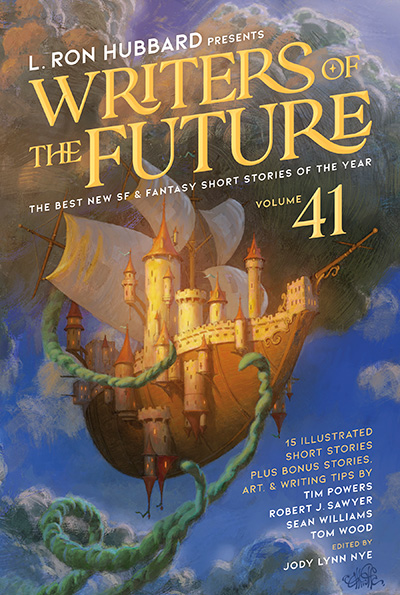
L. Ron Hubbard Presents Writers of the Future Volume 41
Discussion Guide
“Storm Damage”
by T.R. Naus
A beleaguered scientist discovers time travel is possible, but a brewing storm threatens to erase his legacy.
- We often hear about how close we are to the brink of destruction: war, plagues, global warming, nuclear accidents, etc. How close do you think we’ve actually come to destroying ourselves? Have we been saved by our resilience, through luck, or do we wait for somebody (or something like technology) to save us?
- What compromises did Dr. Gregors make to advance his vision before getting to Stanley’s cottage? Can we make significant changes and pursue big dreams without making compromises? How far are you willing to go to make your dream happen?
- Why wouldn’t Stanley let Dr. Gregors try to find an alternative to resetting the timeline? Explain why this was the right or wrong decision.
- Ultimately, Dr. Gregors had to choose between his dream and the common good. How easily could you give up something that you felt defined you? Share real-world examples of choices—yours or others’—and how they reflect a decision between personal dreams and the common good.
“Blackbird Stone”
by Ian Keith
When a door to eternity opens in a downtown doctor’s office, a man and a woman from opposite sides forge a marriage of love between irreconcilable universes.
- The story is framed as a letter from a father to his daughter in which he recounts their family’s history. Why do you think the father, Kevin, wrote this letter? Which of the facts he relates might his time-hopping child be unaware of?
- Kevin sends his marriage into a time-traveling tailspin when he violates his wife’s proscription against calling her by any name at all. Do you agree with his willfully anonymous wife’s belief that names are barriers between people, or with Kevin’s belief that names help us hold on to one another? What function does the name their daughter gives herself serve?
- Kevin’s daughter is a self-made woman, quite literally. In what ways are Kevin and his name-averse wife self-made? How do their different natures and backgrounds influence their daughter’s identity?
“Kill Switch”
by Robert F. Lowell
When an obsolete police robot gets one last chance to avoid the salvage yard, he finds the line between justice and murder is as thin as a silicon wafer.
- What are some potential advantages and disadvantages of using AI and robots for law enforcement? Consider roles AI might play in the justice system—police, tax auditors, prosecuting and defense attorneys, judges, jurors, etc.
- Artificial General Intelligence (AGI) is a type of artificial intelligence that matches or surpasses human cognitive capabilities across a wide range of cognitive tasks. Should an entity possessing AGI be considered a person? What legal rights, if any, should such an entity have?
- Are the actions Lem takes to resolve the dilemma he and Aisha face justifiable? Why or why not?
- Aisha believes that Lem has a soul. Lem disagrees. Whose argument is stronger?
“Message” and “How to View Art”
by L. Ron Hubbard
The essence of art lies in its message; this article reveals how to craft meaningful works by staying present and connecting with your audience.
- The essay suggests that the integration of message is what makes a work of art successful. Can you think of a time when a strong message improved a work, or when a lack of message weakened it?
- Hubbard discusses the importance of assuming the audience’s perspective when evaluating a work of art. How do you think different audiences (e.g., general public vs. critics vs. niche communities) impact the way art is received?
“Tough Old Man”
by L. Ron Hubbard
A rookie constable on a desolate alien outpost faces the ultimate trial: proving himself under the guidance of the legendary Old Keno, whose training methods are as brutal as the terrain.
- The story mixes classic Western and frontier themes with science fiction elements. How does “Tough Old Man” blend these genres? Do you think the story would have worked as well if it were purely a Western or purely a sci-fi tale? Why or why not?
- Moffat initially resents Old Keno’s relentless testing and sees it as an effort to break him. By the end, he understands its purpose. Have you ever experienced a difficult challenge that later turned out to be a valuable learning experience?
- The story plays with expectations, particularly regarding age, experience, and endurance. How does your perception of Old Keno evolve throughout the story? Did the final reveal surprise you? Why or why not?
“Karma Birds”
by Lauren McGuire
As Claire and her sisters are on the run to avoid the deadly birds, a stop for gas may throw them into mortal danger.
- Claire is thrust into the role of caregiver to her young sisters. Do you think her identity as a teenager helped her or hindered her? How do you think you would have fared in Claire’s world?
- “Karma Birds” explores a forced morality. Do you think it would work? Do you think morality or even kindness can be forced or legislated?
- In your opinion, do any of the characters make immoral choices that go unpunished? Why or why not?
“The Boy from Elsewhen”
by Barlow Crassmont
In a world of mandated technology, one boy’s defiance sparks intrigue, envy, and a desire for forgotten freedoms.
- How much social media is too much for a person to consume in a given day? The speculative fear of AI’s takeover of humanity is a commonplace topic; yet, is it as far-fetched as it’s made out to be? Given how an average human cannot go even a few hours without glancing at their phone, how would you define your own dependency on social media in general? What is the longest you could go without your phone? A day? A week? Longer . . .? Or would merely a few hours away from your little black mirror be enough to cause a nervous breakdown? Explain.
- Do you think Visar is human? Why or why not? How does his behavior compare to a contemporary human child, or even those of the 18th and 19th centuries?
- What is the future of human education? Will people continue to teach in the traditional form, human adult to human child, or will we resort to AI in-class instruction? Which method is more beneficial to the advancement of the human race, and why or why not?
“Code L1”
by Andrew Jackson
On an uncharted jungle world, a survey team meets an impossible horror from beyond death itself.
- In “Code L1,” fantastic worlds are sold like common houses. Do you believe humanity would explore or exploit space, if we had the means? What might that look like and what might the ramifications be?
- Do you believe aliens are out there, somewhere? If so, why haven’t we seen any signs yet?
- We often have preconceived ideas of first contact situations between peoples. These aliens are inherently hostile but may not always have been so. Can you think of any examples from history when two radically different civilizations encountered each other for the first time? What happened and why?
- Yasmin tries to imagine how Leaper society worked, before they went “extinct.” She often attributes human function to much of the alien world. Do you think alien civilizations might resemble ours in any way, or would they be so different as to be unrecognizable?
“It Don’t Mean a Thing (If It Ain’t Got That Theme)”
by Robert J. Sawyer
Sawyer reveals how provocative themes make fiction relevant, transformative, and unforgettable.
- Sawyer argues that theme is what makes a story resonate beyond simple entertainment. Do you agree? Can you think of a book or movie that illustrates this idea?
- The article gives examples of science fiction stories with strong themes, such as Frankenstein and The Time Machine. How does science fiction lend itself particularly well to exploring deeper themes?
- Sawyer suggests that research without preconceived notions leads to more provocative themes. How might this approach be applied outside of fiction writing—such as in journalism, history, or even everyday decision-making?
- In your opinion, what makes a theme “provocative” versus simply a message? Can a story be too focused on theme at the expense of entertainment? Why or why not?
“Under False Colours”
by Sean Williams
When a ship emerges from the depths of a gas giant, a solitary observer intervenes, unraveling an ancient cycle of survival, identity, and evolution.
- Keeper Carpinquell is an “art” (artificial mind) with a swarm of semi-independent “algs” (algorithms) for assistants. How do you feel about the possibility that AI might surpass us, in the future?
- Our experience of the world around us is filtered entirely through our mind and senses. This can lead to misunderstandings of what is real and what isn’t. Keeper Carpinquell made such an error: have you?
- How would you describe the polacca that Keeper Carpinquell meets? Is it an independent alien being, is it a cell in a much larger alien body, or is it something in between? What might your answer reveal about humans?
“Ascii”
by Randyn C.J. Bartholomew
A cheerful self-driving car gives a ride to a reclusive writer, and during the trip faces a choice with world-altering ramifications.
- AI is a fast-evolving field. Do you find it believable that an AI could ever have a personality similar to Ascii? Or are there certain limits beyond which no non-organic being could ever surpass?
- Artur Messi wrote a book which views his society as too bland and not sufficiently stormy. He wishes to return to a past in which humans have more control over their own destiny, even if that results in more turmoil. Do you sympathize with his view? Or is a world run by benevolent AI a utopia?
- Ascii views their actions in the context of helping humanity. Do you buy it? Is their ultimate decision based on empathy, as they claim, or is it something else?
- Initially Ascii finds their fellow AI Advisory to be quite annoying. By the end of the story, they seem to have found a new appreciation for Advisory. What do you think accounts for the change of heart? Is it believable that an AI could ever have a feeling of friendship for another AI?
“Slip Stone”
by Sandra Skalski
Carlos Buela doesn’t know where or when he is, or how to find the bus back home—but that rock he bought as a souvenir is to blame.
- If we could travel through time, would it be a good idea to try to change the outcome of past events? What are the possible upsides and downsides? Would the world improve or worsen as a result?
- In this story, Carlos asks Leo, “What’s wrong with changing the past to make things better?” Leo answers,“It never works. You can’t make things better. Only worse.” Do you suppose this is true? Why or why not?
- If you could travel through time and witness an event or meet a person, what or who would it be?
“The Stench of Freedom”
by Joel C. Scoberg
In a lightning-powered city, a father confronts the rotten truth of the man he has become as he discovers that no one is truly free in a society built on oppression.
- Consider the ethical implications of forcefully exploiting an individual (or a small minority of individuals) to benefit the wider community. Can this ever be justified?
- Aside from the resistance movement, the Undergrid, does it appear that everyone else is comfortable with the exploitation of Lightning elementals? How is non-conformance shown, however minor?
- It is only through becoming a parent to a Lightning elemental that Hywel accepts the injustice of the system he willingly served. Discuss how ambition and reward can allow someone to overlook, or even justify, the ill treatment of others, and what it takes for someone to change their view. Have you experienced a situation that made you radically change your view?
- In the story, Hywel is forced to confront the truth of the man he really is and acknowledge the terrible things he has done, which leads him to seek a way to redeem himself. Do you think it is possible for Hywel to atone for his past actions? If you were a Lightning elemental (or relative of one), what would it take for you to forgive him?
“An Artist’s Path”
by Tom Wood
Wood shares how ambition, patience, and embracing uncertainty led him from sketching dinosaurs to a thriving career in the fantasy art world.
- The essay suggests that artists are “made” rather than “born.” Do you agree? How much do talent, environment, and determination each contribute to artistic success?
- Wood emphasizes the importance of surrounding yourself with talented peers and learning from them. How does competition and collaboration shape artistic or creative growth?
- How much of success is about skill versus willingness to take risks?
“My Name Was Tom”
by Tim Powers
A man trapped on an endless ship searches for his wife amid strange, forgotten decks and haunting memories.
- The narrator says that he and his fellow passengers on the nameless ship “became” aboard, rather than “came” aboard. The implication is that they never actually walked up any gangway ramp, but simply discovered they were aboard. What does this imply about the voyage?
- The narrator is determined not to go forward into the unknown. This could be construed as cowardice. Is it?
- The vast ship could represent a Purgatory for deceased souls, and its eventual destination might be Heaven. What evidence is there for or against this interpretation?
“The Rune Witch”
by Jefferson Snow
In the wake of a devastating tragedy, the last member of a magical sisterhood must choose between forgiveness and unleashing a vengeful demon.
- Becoming a protector often requires one to sacrifice aspects of their humanity—innocence, reverence for life, or deep human connection. How might these sacrifices affect a person’s ability to defend others? In what ways could these sacrifices strip away the very qualities that make life and relationships worth protecting?
- In a later scene, the village elders are forced to hold a trial and make a difficult decision. Why might their verdict be justified or flawed?
- By the end of the story, Jindei finds herself in a very different place, but her bloodline is still the only thing that can keep Shijai in his prison. Where should she go from here?
“Thirty Minutes or It’s a Paradox”
by Patrick MacPhee
When a pizza delivery guy meets his time-traveling future selves, he must juggle conspiracies, collapsing timelines, and cooling pizzas.
- How would you rank the future Terrys in terms of:
Which would make the better friend?
b. Which is the most successful?
c. Which is the happiest? - What would you do with a time machine? What would you do with one if you knew that there might be other time travelers out there who might be watching you?
- How could life have meaning without the relentless and irreversible passage of time?
“A World of Repetitions”
by Seth Atwater Jr.
The world is trapped in a thirty-four-hour time loop where everything resets except memories. With reality fractured, humanity struggles to forge a new normal.
- At the beginning of the story, Adam Amaranthus is very attached to his daily routine. How does having this routine disrupted change him as a person? What importance does mental flexibility have for each of us.
- Diana is unmoving in her goal of raising children, even in a situation where it seems impossible. Do you think her stubbornness on this point is a positive or negative quality? Why? What would you do if something happened to make your life’s ambition suddenly seem unreachable? Would you still try to reach for it?
- Adam meets and works with many different people whose lives are impacted by the time loop in distinct ways. How do you think your life would be affected if the world reset every thirty-four hours? What part of your everyday experience would change the most?
- What other societal ramifications could result from a 34-hour time loop where memories remain, but the physical world doesn’t change?
Time Travel Stories
- It has been said that time travel stories are among the most difficult to write well. The author must be concerned with maintaining the consistency of the timelines and dealing plausibly with any paradoxes created within the story. Three of the stories in this volume deal with time travel, and one more deals with a day that is “frozen” in time, repeating itself over 2000 times.
- Describe the method(s) or mechanism(s) employed to travel in time in each story. Which method seems most plausible? How do these methods compare with other means of time travel employed in other stories (or movies or other media) that you have encountered?
- Do you think we will eventually figure out a way to move through time? Why or why not? What obstacles will we face if we gain the ability?